

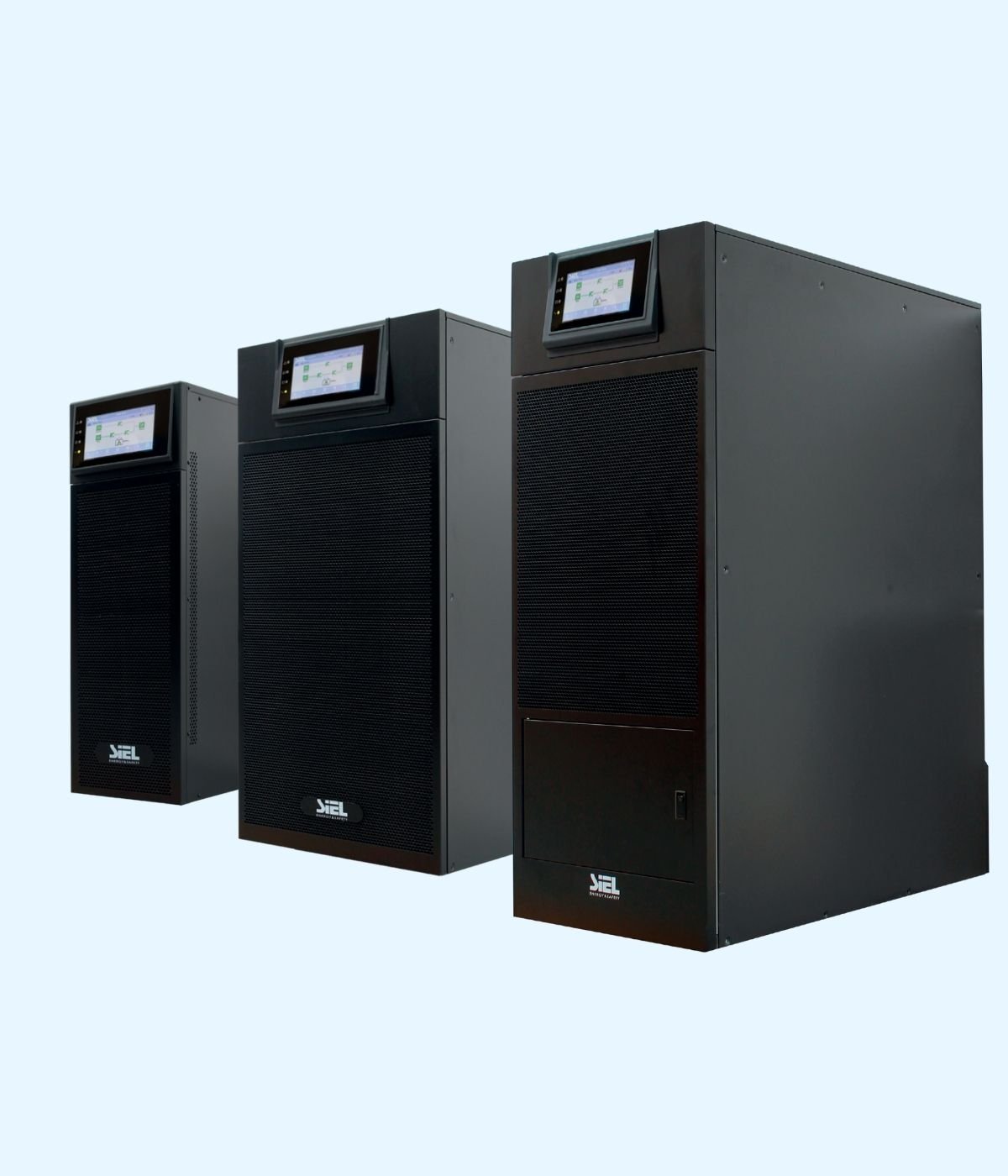
A 150kVA UPS in Kenya protects up to 150 kW of critical load, so it suits a mid-size data centre, a county referral hospital, a bank’s head office or a factory control room. At Encom, you have two SIEL choices around this size: the Safepower S 150K and the slightly larger Safepower Evo HF 160K. Both are three-phase online double conversion units that we supply on order and quote per project.
Prices and specs checked on 29 October 2026.
Key takeaways
- The SIEL Safepower S 150K gives the full 150 kW, while the Evo HF 160K gives 160 kW, because both have an output power factor of 1.
- At full load, a 150kVA UPS draws about 217 A per phase on a 400 V supply, and a 160kVA unit draws about 231 A.
- The Safepower S 150K weighs 190 kg, while the Evo HF 160K weighs 450 kg, according to SIEL.
- At full load, the Safepower S 150K gives off about 5.4 kW of heat, or roughly 18,600 BTU per hour.
- Kenyan electricity customers had about 8.39 hours of outages a month in the first half of 2025/26, according to EPRA figures.
What is the 150kVA UPS price in Kenya?
There is no fixed shelf price for a 150kVA UPS in Kenya, because the battery bank changes the total so much. For example, 10 minutes of backup at 150 kW needs far fewer batteries than an hour does. So we quote each SIEL unit once we know your load, your runtime and your site. Also, all Encom prices exclude VAT.
In particular, five things move the final figure:
- The model. Safepower S 150K or Evo HF 160K, since each fits a different site.
- The battery type. Standard VRLA blocks, or lithium (LiFePO4) on the Evo HF.
- Battery cabinets. At this size, every battery sits in an external cabinet, so the cabinet count follows your runtime.
- Redundancy. One unit, or two in parallel as N+1 when downtime is not an option.
- Installation. Cabling, breakers and a bypass panel, as well as delivery to your plant room.
What can a 150kVA UPS run?
Because its power factor is 1, a SIEL 150kVA UPS carries up to 150 kW of running load. For instance, that covers about 15 server racks at 10 kW each, the theatres, ICU and labs of a hospital, or the PLCs and drives of a bottling line.
However, we advise running a UPS at no more than about 80% of its rating. So a 150kVA unit fits a planned load of about 120 kW, while a 160kVA unit fits about 128 kW. That leaves room for growth, as well as for start-up surges.
If your load is lower than this, our 100kVA SIEL guide and our guide to the 120kVA SIEL models cover the steps below.
What is the 150kVA UPS full load current?
At 400 V three-phase, a 150kVA UPS draws about 217 A per phase at full output. The formula is I = kVA x 1000 / (1.732 x V), so 150,000 / (1.732 x 400) gives 216.5 A.
| Supply voltage | 150 kVA | 160 kVA |
|---|---|---|
| 380 V | About 228 A | About 243 A |
| 400 V | About 217 A | About 231 A |
| 415 V | About 209 A | About 223 A |
These figures help you plan breakers and cables early. Still, cable size also depends on run length and how the cable runs, so a licensed electrician must confirm it. In Kenya, this work falls under EPRA’s Electrical Installation Work Rules.
Safepower S 150K or Evo HF 160K: which SIEL fits?
Pick the Safepower S 150K for a compact, light cabinet with a touchscreen, and the Evo HF 160K for extra headroom, bigger parallel systems and lithium batteries.
| Spec | Safepower S 150K | Evo HF 160K |
|---|---|---|
| Power | 150 kW | 160 kW |
| Online efficiency | Up to 96.5% | Up to 96.2% |
| Units in parallel | Up to 4 | Up to 8 |
| Size (W x D x H) | 442 x 850 x 1200 mm | 840 x 1050 x 1900 mm |
| Weight | 190 kg | 450 kg |
| Battery string | 30 to 50 blocks | 40 blocks, VRLA or LiFePO4 |
When the Safepower S 150K makes sense
The SIEL Safepower S 150K suits plant rooms where space is tight. Its cabinet is only 442 mm wide, so it fits where a wider unit cannot. It also has a 7 inch touchscreen, a diesel mode input and a wide input range of 208 to 478 V, which helps on generator sites.
In addition, at 190 kg it is far easier to move up a ramp or into a lift than a 450 kg cabinet. However, it runs up to four units in parallel, so its ceiling is 600 kVA.
When the Evo HF 160K makes sense
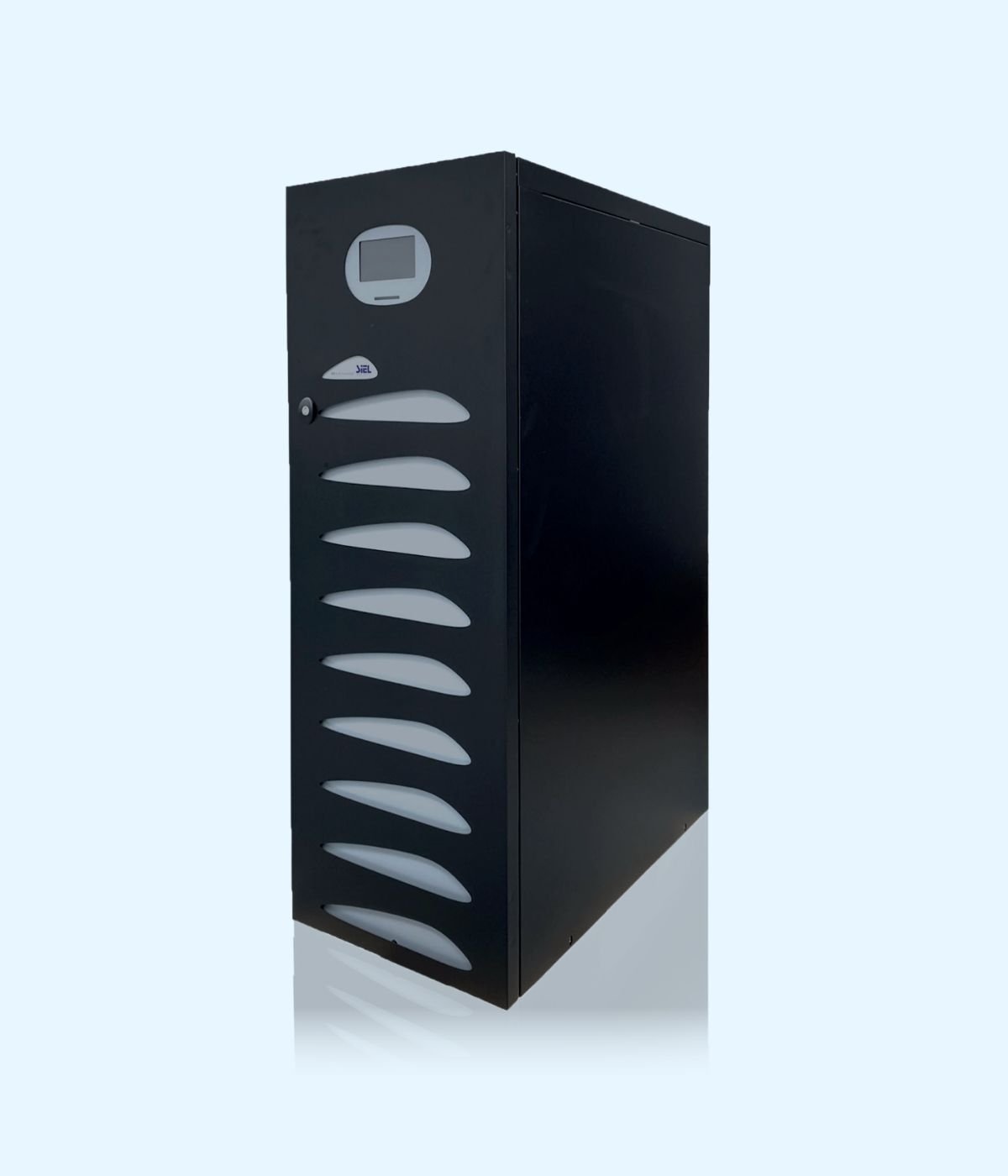
The SIEL Safepower Evo HF 160K suits sites that plan to grow. It gives 10 kW more than the 150K, and up to eight units can run in parallel, which takes you to 1.28 MW. SIEL also lists a lithium (LiFePO4) battery option for it.
SIEL describes the range as “ideal for the protection of computer networks, telecommunications and critical systems in general.”
How many batteries does a 150kVA UPS need?
The Safepower S 150K accepts strings of 30 to 50 blocks of 12 V. In contrast, the Evo HF 160K uses strings of 40 blocks, split 20 + 20 around a centre point. Note that SIEL says strings of 30 to 34 blocks lower the S 150K’s output power factor to 0.8 or 0.9, so we plan full length strings of 36 blocks or more.
Neither model has room for batteries inside at this size. So every battery sits in external cabinets, and we add strings in parallel for longer backup. The Safepower S 150K also charges at up to 60 A, while the Evo HF 160K charges at up to 25 A. As a result, the Safepower S refills a large bank faster after a long outage.
Heat matters as much as count. Schneider Electric warns that “every 8°C (15°F) increase in temperature will cut the battery’s life in half.” So in Nairobi, Mombasa or Kisumu, keep the battery room cooled to about 20 to 25 °C.
How long will a 150kVA UPS in Kenya last in an outage?
Backup time depends on your load and your battery bank, so there is no single answer. For example, a 150kVA UPS at half load runs much longer than one at full load on the same batteries. Your target also depends on whether you have a generator.
- With a generator: 10 to 15 minutes is usually enough, since the generator carries the long outage.
- Without a generator: plan for your longest likely outage instead. Customers face about 8.39 hours of outages a month, according to EPRA data reported by People Daily.
- Planned outages: Kenya Power posts maintenance notices on its official X account, so check how long they last in your area.
What size generator suits a 150kVA UPS?
Plan for a generator of about 190 to 320 kVA when it only feeds a 150 or 160 kVA UPS. UK specialist UPS Systems calls it “a good rule of thumb” to oversize a generator between 1.25 and 2 times the UPS output. Meanwhile, Schneider Electric suggests 1.5 to 2 times the total load on the set.
The reason is distortion. Consulting-Specifying Engineer warns that “harmonic distortion can cause excessive heating at the generator”, and it notes that a 6-pulse rectifier typically has about 30% THD. By comparison, both SIEL models keep input distortion (THDi) at 3% or less, with an input power factor of 0.99. So they sit at the gentle end of the range. Still, your electrician should confirm the final size.
What is the 150kVA UPS heat dissipation?
At full load, the Safepower S 150K gives off about 5.4 kW of heat, or roughly 18,600 BTU per hour. The Evo HF 160K gives off about 6.3 kW, or roughly 21,600 BTU per hour. We worked these out from SIEL’s online efficiency figures of 96.5% and 96.2%.
In ECO mode at 99%, that heat falls to about 1.5 to 1.6 kW. However, ECO mode passes mains power straight through most of the time, so we keep critical sites on full double conversion. Your air conditioning must therefore handle the full-load figure, as well as the heat from the battery room.
What are the 150kVA UPS dimensions and weight?
The Safepower S 150K measures 442 x 850 x 1200 mm and weighs 190 kg. Meanwhile, the Evo HF 160K measures 840 x 1050 x 1900 mm and weighs 450 kg. Both figures exclude battery cabinets.
Both put about 510 kg on each square metre of floor, since the light S 150K also has a small footprint. So ask your engineer to check the slab, as well as door widths and lift limits, before delivery day. Because both cabinets are IP20 as standard, keep them indoors, cool and away from dust. SIEL rates both for 0 to 40 °C and up to 95% humidity without condensation.
How to get a SIEL quote in Kenya
To quote quickly, we need your load in kW or an equipment list, as well as your supply voltage. We also need your runtime and whether you have a generator. Then we come back with the right model and battery setup. Encom Digital is the only retailer of SIEL in Kenya and East Africa. Request a quote on WhatsApp on +254 714 962 072, or Email us.
For server halls, also read our data centre UPS guide on redundancy and batteries. If you are still working out phases, see how to size a three phase UPS for your site. Finally, compare every range in our SIEL UPS buyer’s guide or browse the critical and industrial UPS range.
Frequently asked questions
Price and buying
What is the 150kVA UPS price in Kenya?
We quote each SIEL 150K or 160K per project, because the battery bank for your runtime sets most of the cost. Send us your load and runtime, and we will quote. Also, our prices exclude VAT.
What does a 150 kVA UPS battery cost?
It depends on your backup time and battery type. Every quote includes batteries and cabinets sized for your runtime, so you see the full cost in one figure.
Where can I buy a SIEL 150kVA UPS in Kenya?
Encom Digital in Nairobi is the only retailer of SIEL UPS systems in Kenya and East Africa. We supply each unit on order, so it arrives set up for your load.
Sizing and specifications
What is the 150 kVA UPS full load current?
About 217 A per phase at 400 V three-phase. Similarly, it is about 228 A at 380 V and about 209 A at 415 V.
How many kW is a 150kVA UPS?
The SIEL Safepower S 150K gives 150 kW, since its power factor is 1. In contrast, a unit rated at 0.8 gives only 120 kW.
Should I choose 150 kVA or 160 kVA?
Choose the 150K when space and weight are tight. Otherwise, pick the 160K when you want more headroom, lithium batteries or up to eight units in parallel.
Batteries, generators and backup
How many batteries does a 150kVA UPS use?
The Safepower S 150K takes strings of 36 to 50 blocks of 12 V at full power. Then we add strings in parallel until you reach your backup time.
Can a 160kVA UPS use lithium batteries?
Yes, the Evo HF 160K can. It ships with VRLA as standard, while LiFePO4 is an option.
Does a 150kVA UPS work with a generator?
Yes. Because both SIEL models keep THDi at 3% or less, they are gentle on generators. Even so, plan a set of about 190 to 320 kVA.
Can two units run together for N+1?
Yes. For example, two Evo HF 160K units in parallel can carry 160 kW with one spare, and SIEL allows up to eight.