

Today, Tuesday 13 October 2026, Kenya Power has scheduled an outage from 9 am to 5 pm across parts of Westlands and Ngara in Nairobi, with ABC Bank and Paramount Plaza among the premises named. Eight hours without grid power is a normal working day for a lot of Kenyan businesses. For anyone running servers, it is a test of the power chain from the meter to the rack.
That test matters most in a data centre or a large server room. Globally, power remains the leading cause of impactful outages in Uptime Institute’s 2025 outage analysis. This guide is for IT managers, data centre engineers and facilities teams at banks, telcos, hospitals, universities, county offices and colocation sites who are planning or replacing a data centre UPS in Kenya in the 60 to 200 kVA range. It covers redundancy, efficiency, batteries and monitoring, and how the SIEL models we supply fit each decision.
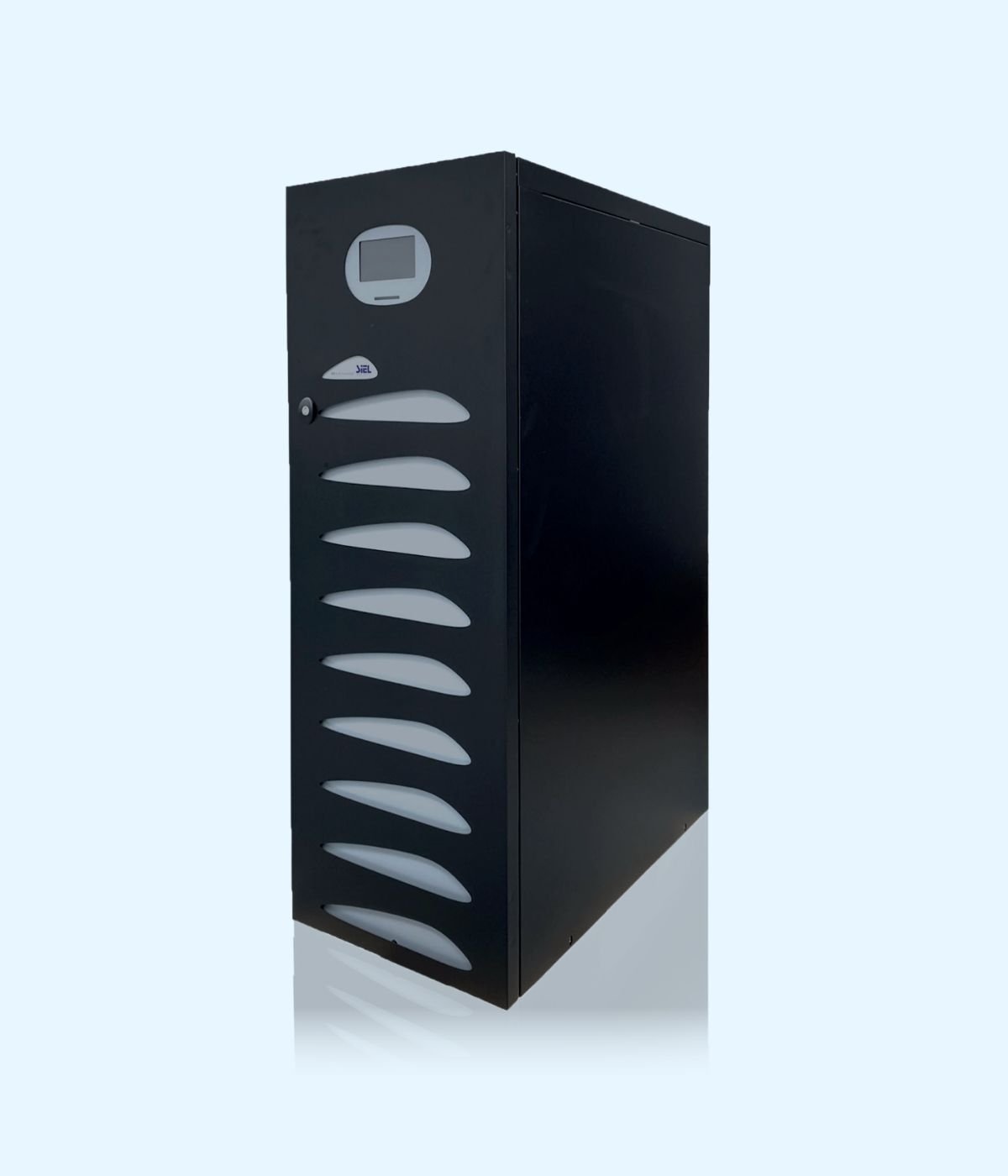
What makes a data centre UPS different
Any online UPS keeps the load running when the mains drops. A data centre UPS has to do more than that, for four reasons:
- It can never be switched off. The UPS itself needs servicing, batteries need replacing and units eventually fail. The design has to allow all of that while the servers keep running.
- It runs 24 hours a day, every day. A small loss in efficiency becomes thousands of kWh a year, and every watt the UPS loses turns into heat your cooling then has to remove.
- Batteries take up real floor space. At 60 to 200 kVA, the battery cabinets can weigh more than the UPS and fill a good part of the room.
- It has to report. The UPS should feed alarms and readings into your network monitoring or building management system, so nobody has to walk into the room to know something is wrong.
Demand for this kind of setup is growing fast. Nairobi hosts 15 of Kenya’s 19 data centres and over 80% of the country’s data centre power capacity, and operators such as iXAfrica and Africa Data Centres are each adding up to 20 MW in the city, according to Capacity Media. Many banks, hospitals and government offices still run their own server rooms alongside those facilities, and those rooms need the same thinking at a smaller scale.
Start with the uptime you need: Tiers, N, N+1 and 2N
The most widely used scale for data centre reliability is the Uptime Institute Tier Classification. You do not need a certified Tier facility to use it. It is a clear way to agree, with management and with your engineers, how much downtime the business can accept.
| Tier | What Uptime Institute requires | What it means for the UPS |
|---|---|---|
| Tier I | A UPS, dedicated cooling and a generator. Maintenance needs a full shutdown. | One UPS sized for the load (N). Plan downtime for every service visit. |
| Tier II | Redundant capacity components, such as UPS modules and generators. | A spare UPS unit in parallel (N+1), so one unit can be removed without stopping the load. |
| Tier III | Concurrently maintainable. Any part can be shut down for maintenance without affecting IT, with redundant distribution paths. | Redundant UPS capacity plus a second path to the racks, so a UPS, breaker or cable can be worked on while the servers run. |
| Tier IV | Fault tolerant. Independent, physically isolated systems, so a failure does not affect IT operations. | Two independent UPS systems, each able to carry the full load (2N), feeding separate A and B supplies to the racks. |
In an N+1 design, several identical UPS units share a common output bus, with one more unit than the load needs. A 2N design uses two completely independent UPS systems, each capable of carrying the entire critical load on its own. 2N only pays off fully when your servers and switches have dual power supplies, one on each feed.
A worked example: a 120 kW server room in Upper Hill
Take a bank’s primary server room with 120 kW of measured IT load. SIEL rates both the Safepower S and Safepower Evo HF at an output power factor of 1, so kVA and kW are the same and the sums are simple. Here are three ways to build it with Evo HF units:
| Design | UPS setup | Load per unit, normal day | If one unit fails |
|---|---|---|---|
| N | 1 x Evo HF 160K | 75% | Load goes to bypass, on raw mains |
| N+1 | 3 x Evo HF 80K in parallel | 50% | Two units carry it at 75% each |
| 2N | 2 separate Evo HF 160K systems on A and B feeds | 37.5% | The other system carries it at 75% |
The N+1 layout is where most Kenyan enterprise server rooms land. It removes the single point of failure without doubling the investment, and it scales. Safepower Evo HF runs up to eight units in parallel, so the same site can add a fourth 80K when the load grows. Safepower S runs up to four in parallel, which suits rooms where growth is more predictable. Our three phase UPS sizing guide covers how to measure each phase before you settle on a size.
Efficiency: what UPS losses cost you over a year
Data centres track efficiency with PUE, power usage effectiveness. PUE was created by members of The Green Grid and is total facility power divided by IT equipment power, so the closer it gets to 1.0, the less energy you spend on anything other than computing. The UPS sits in the middle of that sum: everything it loses is counted, and the heat it gives off adds cooling load on top. Progress is slow across the industry, with average PUE showing little change for the sixth year in a row in Uptime Institute’s 2025 survey.
Modern UPS systems typically run at about 94% to 97% in normal double conversion mode. SIEL rates the Safepower Evo HF at up to 96.6% online on the 10K to 60K models and up to 96.2% on the 80K to 200K models, and the Safepower S at up to 96.5%. Here is what that gap means for a 100 kW load running all year:
| UPS efficiency | Power drawn for 100 kW of IT | Lost as heat | Energy lost per year |
|---|---|---|---|
| 94% | 106.4 kW | 6.4 kW | About 55,900 kWh |
| 96.2% | 104.0 kW | 4.0 kW | About 34,600 kWh |
That is a difference of roughly 21,000 kWh a year before cooling. Multiply it by the energy rate on your own KPLC bill to see the figure in shillings. One caution: manufacturers quote “up to” efficiency at the best operating point. In an N+1 or 2N design each unit runs at partial load, so ask us for the efficiency at the load your units will actually carry.
Should you use ECO mode?
Both SIEL three phase ranges offer an ECO mode rated at up to 99% efficiency. In ECO mode, utility power bypasses the rectifier and inverter and feeds the load directly, and the UPS switches back to double conversion when it sees a disturbance. The same source points out the catch: on bypass, sags, surges and frequency swings can reach the load until the switch happens, and where utility power quality is poor the UPS spends little time in bypass, so the savings shrink.
On many Kenyan feeders, with frequent dips, outages and generator changeovers, that is exactly the situation. Our advice for IT loads is to run in full double conversion by default, and only consider ECO mode after a power quality study at your site shows clean, stable mains.
Batteries: VRLA or lithium
Batteries are usually the biggest maintenance cost on a data centre UPS and the part most likely to let you down. Schneider Electric’s White Paper 229 on VRLA and lithium ion batteries compares the two for data centres and puts numbers on the difference:
| In Schneider’s example | VRLA | Lithium ion |
|---|---|---|
| Expected service life at 25 °C | 4 years (3 to 6 years typical) | 12 years |
| Battery footprint | 5.4 m² | 2.2 m² |
| Battery weight | 11,340 kg | 2,767 kg |
| 10 year total cost of ownership | Baseline | 39% lower |
Lithium costs more up front, but in that example the VRLA batteries would be replaced twice in the time one lithium set lasts. That matters in Kenya, where every replacement means importing heavy batteries, booking an electrician and planning a maintenance window. Lithium is also much lighter, which helps on upper floors where floor loading is a limit.
On the SIEL side, the Safepower Evo HF takes standard VRLA batteries with lithium (LiFePO4) as an option. The Safepower S uses VRLA with an adjustable number of battery blocks, which lets the battery bank be matched to the runtime you want. Larger models in both ranges use external battery cabinets. Keep the battery room cool whichever you choose: for lead acid, every 8 °C rise in temperature halves battery life.
For runtime, most data centres with a generator plan for the generator to start and settle, plus a safety margin, rather than hours on battery. If your site has no generator, plan enough runtime for a controlled shutdown of every system.
Monitoring and integration
A data centre UPS should tell you about a failing battery or an overloaded phase long before it becomes an outage. The two SIEL ranges approach this differently:
- Safepower Evo HF: monitoring via SNMP, RS232 and RS485 Modbus, so it can report into network monitoring tools and building management systems.
- Safepower S: a 7 inch touchscreen, RS232, RS485, LAN, Modbus, dry contacts and two intelligent slots, plus a remote emergency power off input, a diesel mode input and a backfeed protection output. The emergency power off input is useful where fire suppression or safety systems need to cut the UPS.

Both ranges are rated VFI-SS-111 under IEC EN 62040-3, run from 0 to 40 °C at up to 95% humidity without condensation, can cold start from batteries during an outage, and draw input current with 3% or less distortion at a 0.99 power factor, which keeps them friendly to the generator. Our guide to online double conversion UPS explains what that rating means in practice.
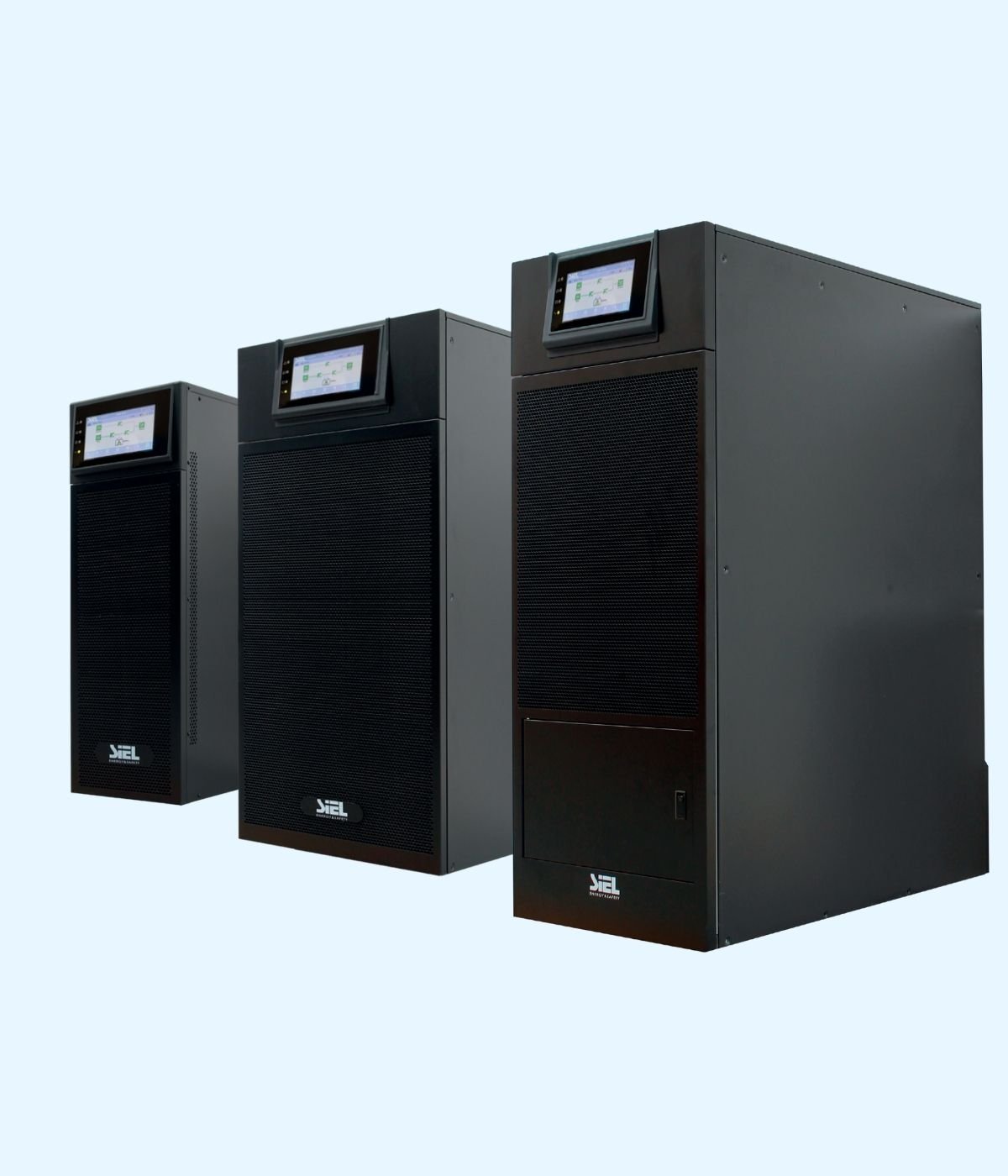
Safepower Evo HF or Safepower S for a data centre?
| What matters in a data centre | Safepower Evo HF | Safepower S |
|---|---|---|
| Units in parallel | Up to 8 | Up to 4 |
| Online efficiency, 80 to 200 kVA | Up to 96.2% | Up to 96.5% |
| Output distortion with non linear load | 1.5% or less | 3% or less |
| Continuous overload | 103% with no time limit | No continuous rating, 110% for 60 minutes |
| Lithium option | Yes, LiFePO4 | No, VRLA |
| Cabinet protection | IP20, IP21 or IP31 optional | IP20 |
| Monitoring | SNMP, RS232, RS485 Modbus | Touchscreen, RS232, RS485, LAN, Modbus, dry contacts, emergency power off |
In short, choose Evo HF when you expect to grow in steps, want lithium batteries, or protect mostly server and network equipment where low output distortion helps. Choose Safepower S when you want slightly higher online efficiency at the larger sizes, a local touchscreen and the wider set of building management connections.
SIEL data centre UPS models from 60 to 200 kVA
| Rating (kVA = kW) | Safepower Evo HF | Safepower S |
|---|---|---|
| 60 kVA | Evo HF 60K | Safepower S 60K |
| 80 kVA | Evo HF 80K | Safepower S 80K |
| 100 kVA | Evo HF 100K | Not in this range |
| 120 kVA | Evo HF 120K | Safepower S 120K |
| 150 kVA | Not in this range | Safepower S 150K |
| 160 kVA | Evo HF 160K | Not in this range |
| 200 kVA | Evo HF 200K | Safepower S 200K |
Smaller sizes from 10 kVA are also available in both ranges, and parallel units take you well past 200 kW. For a single rack or a small comms room on single phase power, our rack mount UPS guide is the better starting point. You can see everything together in the SIEL UPS range.
Getting a quote for a data centre UPS
Encom Digital is SIEL’s only retailer in Kenya and East Africa. Every Safepower S and Safepower Evo HF is supplied on order and configured for your site, so pricing is by quote, and our prices are quoted excluding VAT. To quote quickly, send us:
- Your measured IT load in kW, per phase if you have it, and the growth you expect over the next few years
- The design you are aiming for: N, N+1 or 2N, and whether your equipment has dual power supplies
- The runtime you need and your generator rating
- Your battery preference, VRLA or lithium
- The monitoring system the UPS must report into
- The room size, floor level and access route for delivery
Request a quote on WhatsApp on +254 714 962 072, or Email us and we will come back with the right models, parallel setup and battery configuration. You can also visit us at Rehema House, 4th Floor, Standard Street, Nairobi.
Frequently asked questions
What is a data centre UPS?
An online UPS, usually three phase, that protects the servers, storage and network equipment in a data centre or server room. It is designed to run around the clock, to be serviced without switching off the load, and to report its status to your monitoring systems.
What size UPS does my data centre need?
Measure your real IT load in kW, add room for growth, then choose a size and redundancy design. With SIEL Safepower S and Evo HF, kVA equals kW, so a 120 kW load fits a 160 kVA unit at 75%, or three 80 kVA units in N+1.
What is the difference between N+1 and 2N?
N+1 runs one more UPS unit than the load needs on a shared output, so any one unit can fail or be serviced. 2N uses two completely independent UPS systems, each able to carry the full load, usually feeding separate A and B supplies to dual corded equipment.
Which UPS design matches each Uptime Tier?
Tier I needs a UPS with no redundancy. Tier II adds redundant components such as an extra UPS module. Tier III must be concurrently maintainable with redundant distribution paths. Tier IV must be fault tolerant, with independent, physically isolated systems.
How many SIEL UPS units can run in parallel?
Up to eight Safepower Evo HF units, or up to four Safepower S units.
How efficient are SIEL data centre UPS systems?
SIEL rates the Safepower Evo HF at up to 96.6% online on 10K to 60K and up to 96.2% on 80K to 200K, and the Safepower S at up to 96.5%. Both reach up to 99% in ECO mode.
Is ECO mode safe for servers?
In ECO mode the load runs on mains through the bypass and the UPS switches to double conversion when it detects a problem, so some disturbances can reach the load first. On Kenyan supplies with frequent dips, we recommend full double conversion for IT loads unless a power quality study shows clean mains.
Should I choose lithium or VRLA batteries?
Lithium costs more up front but lasts much longer and is far lighter. In Schneider Electric’s White Paper 229 example, lithium lasted 12 years against 4 for VRLA and had a 39% lower 10 year cost of ownership. The Safepower Evo HF offers a LiFePO4 option.
How long should a data centre UPS run on battery?
With a generator, enough to cover its start and a safety margin is usually the target. Without a generator, plan enough runtime for a controlled shutdown. We configure battery cabinets to the runtime you specify.
Can a SIEL UPS report to my monitoring system?
Yes. The Evo HF supports SNMP, RS232 and RS485 Modbus. The Safepower S has RS232, RS485, LAN, Modbus, dry contacts and two intelligent slots.
Can the UPS be cut by our fire system?
The Safepower S has a remote emergency power off input that can be wired to fire or safety systems.
What room conditions does a SIEL UPS need?
Both ranges run from 0 to 40 °C at up to 95% humidity without condensation. Keep the battery area cool, since heat shortens battery life sharply.
How much does a 100 kVA or 200 kVA UPS cost in Kenya?
SIEL units are supplied on order and priced by quote, because cost depends on the model, the number of units, the batteries and installation. Our prices are quoted excluding VAT.
Where can I buy a SIEL data centre UPS in Kenya?
From Encom Digital, SIEL’s only retailer in Kenya and East Africa. Request a quote on WhatsApp on +254 714 962 072 or by email at info@encom.africa.