

On Thursday 10 September 2026, Kenya Power scheduled maintenance outages from 9 am to 5 pm along Bamburi Road and parts of Enterprise Road in Nairobi’s Industrial Area, and around Chemelil Sugar Factory in Kisumu County. That is a full working day without grid power for some of the busiest three phase sites in the country.
If your building runs on a three phase supply and your critical load is more than a few kilowatts, a three phase UPS is what keeps it running through that kind of day, together with a generator. This guide is for facilities managers, electrical engineers and IT managers at hospitals, factories, banks, data rooms and office blocks. It covers how to size a three phase UPS properly, the mistakes that catch people out, and how the two SIEL three phase ranges compare from 10 to 200 kVA.
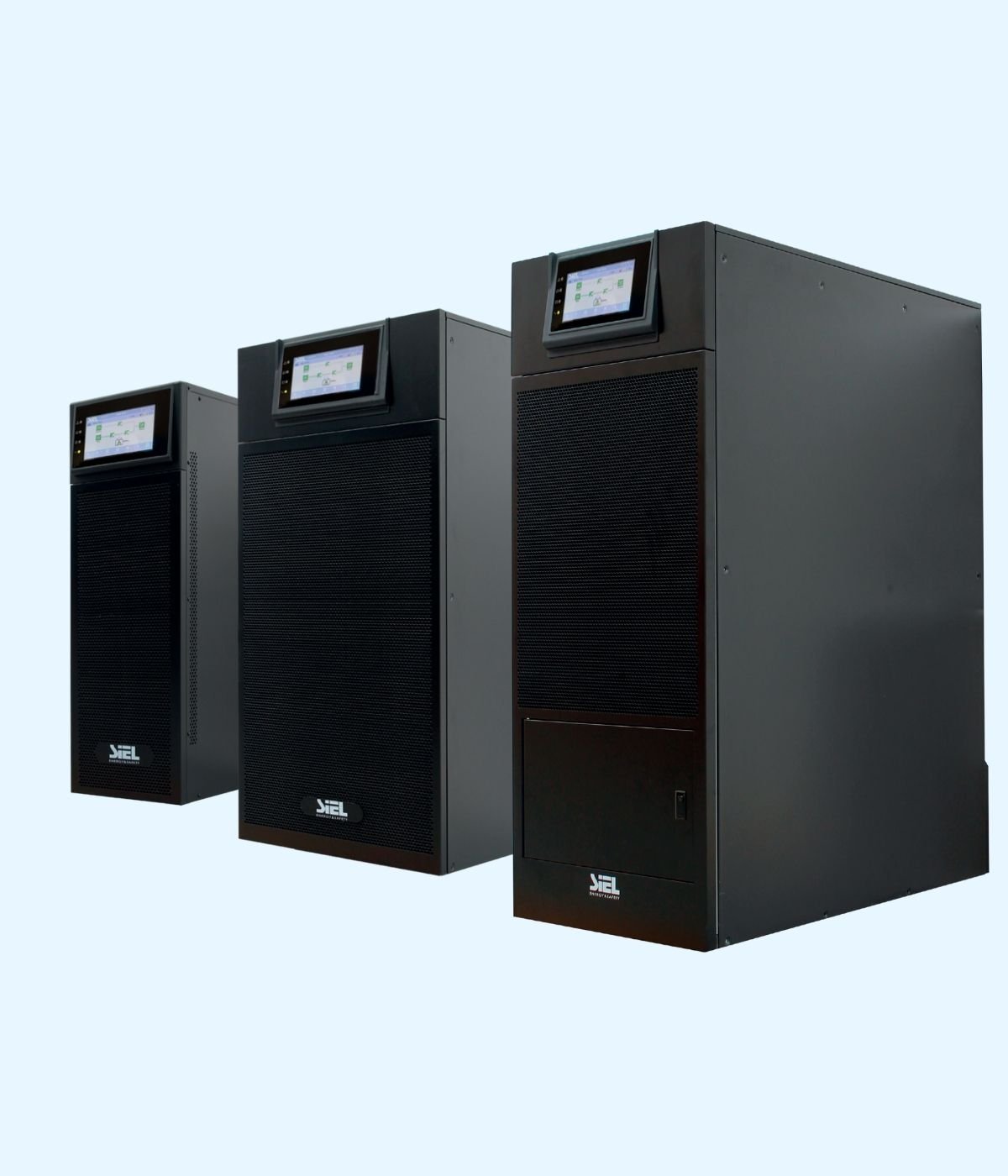
When a three phase UPS is the right choice
Kenya’s three phase supply is 415 V at 50 Hz on four wires: three phases plus neutral. Both SIEL three phase ranges take a 380, 400 or 415 V three phase plus neutral input, so they connect straight to a standard Kenyan three phase board.
Two signs point you to three phase rather than single phase:
- The size of the load. 20 kVA is generally the largest single phase output UPS available, because of the cable sizes the current would need. Three phase units start at around 10 kVA and go much higher.
- What you are protecting. Three phase equipment such as some imaging machines, chillers, pumps and production controls needs a three phase output. A whole floor of single phase IT, spread over three phases at the distribution board, is also better served by one central three phase UPS than by a dozen small ones.
For a single server cabinet or network rack on single phase power, a three phase UPS is more than you need. Our guide to sizing a rack mount UPS covers that case with the SIEL Greenpoint range.
Three sizing mistakes to avoid
1. Mixing up kVA and kW
Your equipment uses real power, measured in kW. A UPS has a kVA rating and a kW rating, and neither one can be exceeded. Many UPS units deliver fewer kW than their kVA figure suggests, so a “40 kVA” unit may only carry 32 or 36 kW. SIEL rates both Safepower S and Safepower Evo HF at an output power factor of 1, so a 40 kVA model delivers 40 kW. Size on your measured kW and the numbers line up. Our guide to the 20kVA UPS runs these numbers for one common size.
2. Looking only at the total, not each phase
This is the one that trips up most three phase plans. A three phase UPS rating is shared across the three phases, so a 120 kVA unit should carry up to 40 kVA on each phase. If most of your single phase loads sit on one phase, that phase can be overloaded while the total still looks fine. The same source warns that uneven loading can lead to conductor overheating.
SIEL designs the Safepower S to run with a fully unbalanced load, which helps on real sites where loads never split evenly. It does not change the per phase limit, so measure each phase separately before you choose a size.
3. Forgetting growth and the overload margin
Loads grow. A hospital adds an ICU bed, a factory adds a line, a bank adds a server. Plan for that, and keep room for start up surges. On the Safepower S, SIEL rates the overload capacity at up to 110% for 60 minutes, up to 125% for 10 minutes and up to 150% for 1 minute, after which the UPS moves the load to bypass. The Safepower Evo HF adds a rating of 103% with no time limit and short bursts of 200% for half a second. Overload capacity is a safety margin for short events, not a reason to size tight. For a worked example from a factory floor, see how to size an industrial UPS.
A worked example: a hospital wing in Nakuru
A private hospital wants to protect a theatre, an ICU, its pharmacy fridges, nurse station computers and the server room. The electrician measures each phase at the distribution board during a busy morning:
| Phase | Measured load | Share of a 40 kVA UPS (13.3 kW per phase) | Share of a 60 kVA UPS (20 kW per phase) |
|---|---|---|---|
| L1 | 15 kW | 113%, overloaded | 75% |
| L2 | 11 kW | 83% | 55% |
| L3 | 8 kW | 60% | 40% |
| Total | 34 kW | 85% | 57% |
On the total alone, a 40 kVA UPS looks like it fits at 85%. Phase by phase, L1 is over its limit. The hospital has two sensible options:
- Rebalance circuits at the board so each phase carries roughly 11 to 12 kW, then use a Safepower S 40K. This works, but leaves little room for new equipment.
- Rebalance and step up to a Safepower S 60K or Safepower Evo HF 60K. Every phase then runs at around 60% or less, with space to grow and longer battery runtime from the same batteries.
For most critical sites, the second option is the one we would recommend.
Safepower S or Safepower Evo HF?
Both ranges are online double conversion UPS systems rated VFI-SS-111 under IEC EN 62040-3, both run at an output power factor of 1, and both cover 10 to 200 kVA. The differences are in how they grow, how they handle batteries and what kind of room they suit. Our SIEL UPS range guide explains the double conversion rating in more detail.
| Feature | Safepower S | Safepower Evo HF |
|---|---|---|
| Sizes we supply | 10, 20, 30, 40, 60, 80, 120, 150 and 200 kVA | 10, 20, 30, 40, 60, 80, 100, 120, 160 and 200 kVA |
| Units in parallel | Up to 4 | Up to 8 |
| Online efficiency | Up to 96.5% | Up to 96.6% (10K to 60K), up to 96.2% (80K to 200K) |
| Output distortion with non linear load | 3% or less | 1.5% or less |
| Overload | 110% for 60 min, 125% for 10 min, 150% for 1 min | 103% continuous, 110% for 60 min, 125% for 10 min, 150% for 1 min |
| Internal batteries | 10K, 20K and 30K | 10K to 60K, up to 3 strings |
| Battery type | VRLA | VRLA standard, LiFePO4 lithium optional |
| Cabinet protection | IP20 | IP20, with IP21 or IP31 optional |
| Display and comms | 7 inch touchscreen, RS232, RS485, LAN, Modbus, dry contacts, remote emergency power off, diesel mode input | SNMP, RS232, RS485 Modbus |
| Single phase output versions | 10K and 20K as 3/1 or 1/1 | 10K and 20K as 3/1 or 1/1 |
Choose Safepower S when
- Floor space is tight. The 10K to 60K models share a cabinet just 250 mm wide.
- Your team wants a local touchscreen and building management connections such as LAN, Modbus and dry contacts.
- You need a remote emergency power off input for fire or safety systems.
- Growth beyond four units in parallel is unlikely.

Choose Safepower Evo HF when
- You expect to grow in steps. Up to eight units in parallel lets you add capacity as the site expands.
- You want lithium (LiFePO4) batteries, or more internal battery space on the 10K to 60K models.
- The room is dusty, such as a plant room or a factory floor. The optional IP21 or IP31 cabinet gives more protection than standard IP20.
- The load is mostly electronic, such as servers and medical equipment, where the lower output distortion is a plus.
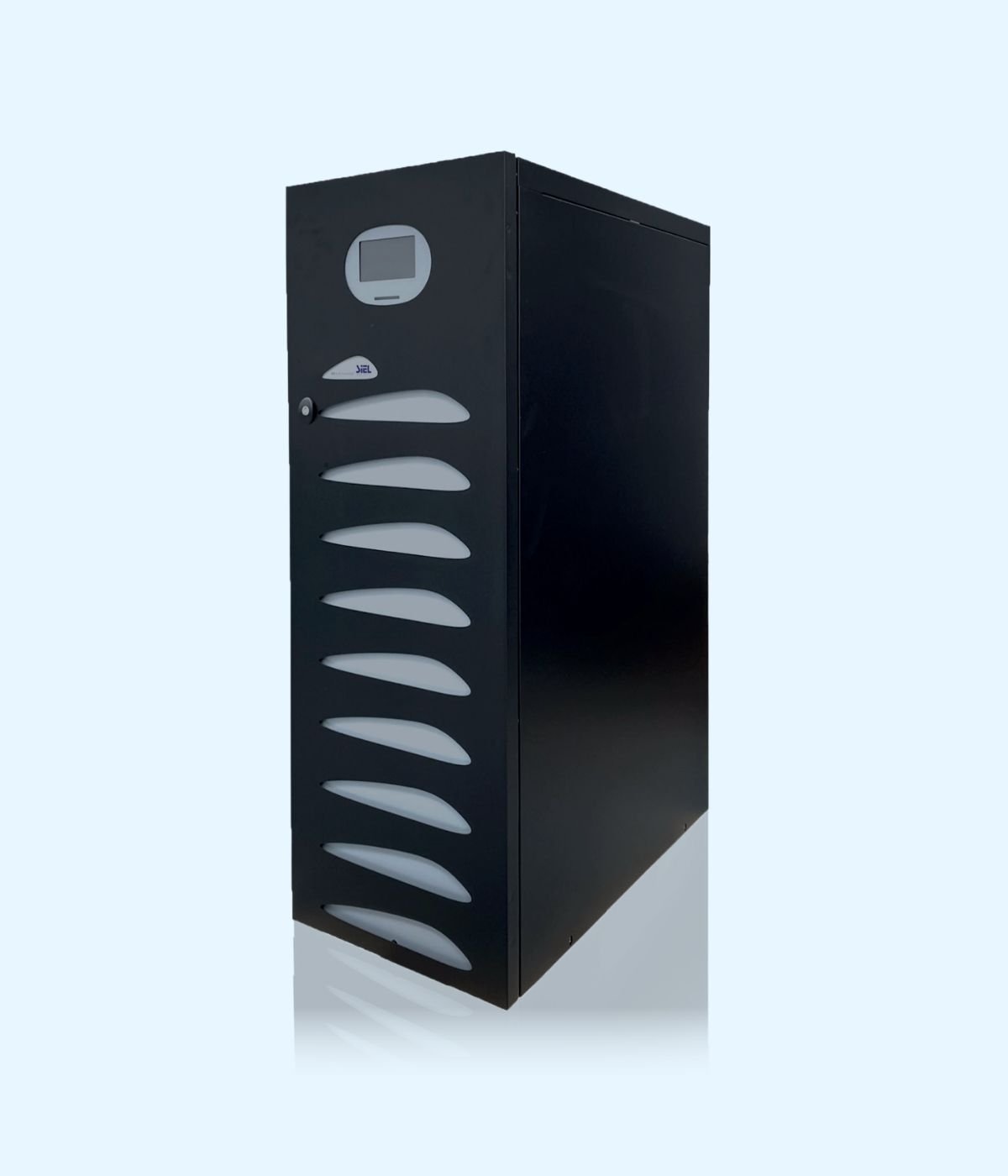
Plan the UPS and the generator together
No UPS battery is meant to carry a hospital wing or a production office through an eight hour Kenya Power maintenance window. On most three phase sites, the UPS covers the gap while the generator starts and settles, and keeps the power clean while the generator runs. That only works if the generator is sized for the UPS.
A common rule of thumb is to oversize the generator by 1.25 to 2 times the UPS output when it supplies only the UPS, and to size it for the full load when it also runs air conditioning, lighting or other equipment. The UPS draws more than its output rating, because it also recharges its batteries after an outage and loses a little power in conversion. A 60 kVA UPS on its own would therefore point to a generator of roughly 75 to 120 kVA.
Two SIEL specifications make this easier. Both ranges draw input current with distortion (THDi) of 3% or less and an input power factor of 0.99 at full load, which keeps the UPS friendly to the generator. The Safepower S also has a dedicated diesel mode input. Share your generator rating with us when you ask for a quote and we will check the match.
Redundancy: when one UPS is not enough
For a theatre, a dealing room or a data room, a single UPS is a single point of failure. In an N+1 setup, an extra UPS shares the load evenly with the others, so if one unit fails or is taken out for service, the rest carry the load on their own. The units in the group need to be the same model and capacity.
Take a 60 kW load. Two Evo HF 60K units in parallel each run at about 50%, and either one can carry the full load alone. Three Evo HF 30K units give the same protection, and the site can add a fourth when the load grows. Safepower S supports up to four units in parallel and Safepower Evo HF up to eight.
Batteries, runtime and the room
- Runtime. With a generator, a short runtime that covers start up plus a margin is usually enough. Without one, plan external battery cabinets for a controlled shutdown, or the runtime your operation truly needs.
- Internal batteries. The Safepower S 10K, 20K and 30K take batteries inside the cabinet. The Evo HF 10K to 60K take up to three internal strings of 9 Ah batteries. Larger models use external battery cabinets.
- Weight. Batteries add a lot. SIEL lists a Safepower S 30K at 71 kg without batteries and 223 kg with them, and an Evo HF 60K at 130 kg and 290 kg. Check floor loading, especially on upper floors.
- Temperature. Both ranges run from 0 to 40 °C at up to 95% humidity without condensation. Batteries last far longer in a cool room, and every 8 °C rise in temperature cuts lead acid battery life in half.
- Cold start. Both ranges can start from batteries when the mains is already off, useful when a site has to restart during a long outage.
A three phase UPS is a fixed electrical installation. Input, output and battery connections should be made by a qualified electrician, with the right breakers and cable sizes for the model.
SIEL three phase UPS models in Kenya
| Rating (kVA = kW) | Safepower S | Safepower Evo HF |
|---|---|---|
| 10 kVA | Safepower S 10K | Evo HF 10K |
| 20 kVA | Safepower S 20K | Evo HF 20K |
| 30 kVA | Safepower S 30K | Evo HF 30K |
| 40 kVA | Safepower S 40K | Evo HF 40K |
| 60 kVA | Safepower S 60K | Evo HF 60K |
| 80 kVA | Safepower S 80K | Evo HF 80K |
| 100 kVA | Not in this range | Evo HF 100K |
| 120 kVA | Safepower S 120K | Evo HF 120K |
| 150 kVA | Safepower S 150K | Not in this range |
| 160 kVA | Not in this range | Evo HF 160K |
| 200 kVA | Safepower S 200K | Evo HF 200K |
If your loads are small and spread around the building, a single phase UPS at each point may still make sense. For a home office or a single workstation, our piece on keeping your work going when stima imeenda is the better place to start.
Getting a quote for a three phase UPS
Encom Digital is SIEL’s only retailer in Kenya and East Africa. Every Safepower S and Safepower Evo HF is supplied on order and configured for your site, so pricing is by quote, and our prices are quoted excluding VAT. To quote quickly, send us:
- The measured load on each phase, or a list of the equipment to protect
- Whether you need three phase or single phase output
- The runtime you want, and your generator rating if you have one
- Any need for redundancy or future growth
- The room size, floor level and access route for delivery
Request a quote on WhatsApp on +254 714 962 072, or Email us and we will come back with the right model, battery setup and configuration. You can also browse the full SIEL UPS range on the shop.
Frequently asked questions
What is a three phase UPS?
A UPS that takes a three phase supply, usually 415 V in Kenya, and delivers protected three phase power to your load. It suits larger sites and loads above roughly 10 to 20 kVA.
When do I need a three phase UPS instead of single phase?
When your building has a three phase supply and your critical load is beyond what a single phase UPS can carry, or when you need to protect three phase equipment. Single phase UPS output generally tops out at about 20 kVA.
How do I size a three phase UPS?
Measure the real load in kW on each phase, not just the total. Each phase can carry one third of the UPS rating. Choose a size that keeps the busiest phase well under its limit, with room for growth.
What happens if my phases are unbalanced?
The busiest phase can overload even if the total looks fine. SIEL designs the Safepower S to run with a fully unbalanced load, but each phase still has its own limit, so rebalancing circuits at the board is good practice.
Is a 40 kVA SIEL UPS also 40 kW?
Yes. Safepower S and Safepower Evo HF have an output power factor of 1, so the kVA and kW ratings are the same.
Can a three phase UPS give a single phase output?
The 10K and 20K models of both Safepower S and Safepower Evo HF are available as 3/1 (three phase in, single phase out) or 1/1 (single phase in and out).
What size generator do I need for my UPS?
A common rule of thumb is 1.25 to 2 times the UPS output when the generator supplies only the UPS. If it also runs other loads, size it for the full load. Send us your generator rating and we will check it against the UPS.
Do SIEL three phase UPS systems work with generators?
Both ranges draw input current with 3% or less distortion and a 0.99 input power factor at full load, which suits generators. The Safepower S also has a diesel mode input.
What is N+1 redundancy?
You run one more UPS than the load needs, with all units sharing the load. If one fails or is serviced, the others carry the load alone. Safepower S runs up to 4 units in parallel and Safepower Evo HF up to 8.
What is the difference between Safepower S and Safepower Evo HF?
Safepower S has a compact 250 mm wide cabinet up to 60K, a 7 inch touchscreen and up to 4 units in parallel. Evo HF allows up to 8 units in parallel, a lithium battery option, more internal battery space up to 60K and an optional IP21 or IP31 cabinet.
How long will a three phase UPS run on battery?
It depends on the load and the batteries fitted. Smaller models have internal batteries, and all models can use external battery cabinets for longer runtime. Tell us the runtime you need and we will configure it.
Can a three phase UPS go in a dusty plant room?
Standard cabinets are IP20. The Safepower Evo HF offers optional IP21 or IP31 protection, which is the better choice for dusty or industrial rooms. Both ranges run from 0 to 40 °C.
How heavy is a three phase UPS?
It varies a lot with batteries. SIEL lists the Safepower S 30K at 71 kg without batteries and 223 kg with them, and the Evo HF 60K at 130 kg and 290 kg. Check floor loading before installation.
How much does a three phase UPS cost in Kenya?
SIEL units are supplied on order and priced by quote, since cost depends on the model, batteries and configuration. Our prices are quoted excluding VAT.
Where can I buy a SIEL three phase UPS in Kenya?
From Encom Digital, SIEL’s only retailer in Kenya and East Africa. Request a quote on WhatsApp on +254 714 962 072 or by email at info@encom.africa.