

In the year to June 2026, the average Kenya Power customer had 3.91 interruptions a month, and each one lasted 3.23 hours on average, up from 2.57 hours the year before, according to EPRA data reported by The Eastleigh Voice. May 2026 was the worst month, with 27.33 hours of outages per customer. If you run a server, a till, a clinic system or a small office network, a 1 to 6 kVA online UPS is usually the right tool for the job. The hard part is picking the size.
This guide is for IT managers, office administrators, clinic and school managers, and business owners choosing a small single-phase online UPS. It explains what each size realistically carries, why a 3kVA online UPS is the size most Kenyan offices end up needing, how long the batteries will actually last, and what to check about sockets and wiring before you order. The models we use throughout are the four smaller SIEL Greenpoint units: 1K, 2K, 3K and 6K.

Why an online UPS at this size
At 1 to 3 kVA you can also buy offline and line-interactive UPS units, and they cost less. The difference shows up on Kenyan power. An online double conversion UPS rebuilds clean AC from DC all the time, so the load never sees the sags, spikes and frequency swings on the incoming line, and there is no switchover gap when stima imeenda. Our guide to how online double conversion works covers the technology in detail.
Generators are the other reason. Many offices and clinics run a standby generator, and a generator’s frequency drifts while it starts and as the load changes. CyberPower, which makes both types, notes that line-interactive units can keep switching to battery on generator power until the battery runs flat, even though the generator is running. Every Greenpoint is listed by SIEL as generator compatible and accepts input from 110 to 300 V, so a sagging generator or a weak rural line does not push it onto battery.
All four models carry the VFI-SS-111 rating under IEC EN 62040-3 and have an output power factor of 1, so the kVA and kW figures are the same. A 3 kVA Greenpoint delivers a full 3 kW. Many UPS units are rated at a power factor of 0.8 or 0.9, so a 3,000 VA unit may deliver only 2,400 W. Always compare kW, not kVA.
1kVA, 2kVA, 3kVA and 6kVA side by side
| Model | Output | Output sockets | Battery string | Size (W x D x H) | Weight |
|---|---|---|---|---|---|
| Greenpoint 1K | 1 kVA / 1 kW | 8 x IEC C13 | 24 V, 12 V 9 Ah AGM blocks | 440 x 325 x 86.5 mm (2U) | 13 kg |
| Greenpoint 2K | 2 kVA / 2 kW | 8 x IEC C13 | 48 V, 12 V 9 Ah AGM blocks | 440 x 460 x 86.5 mm (2U) | 21 kg |
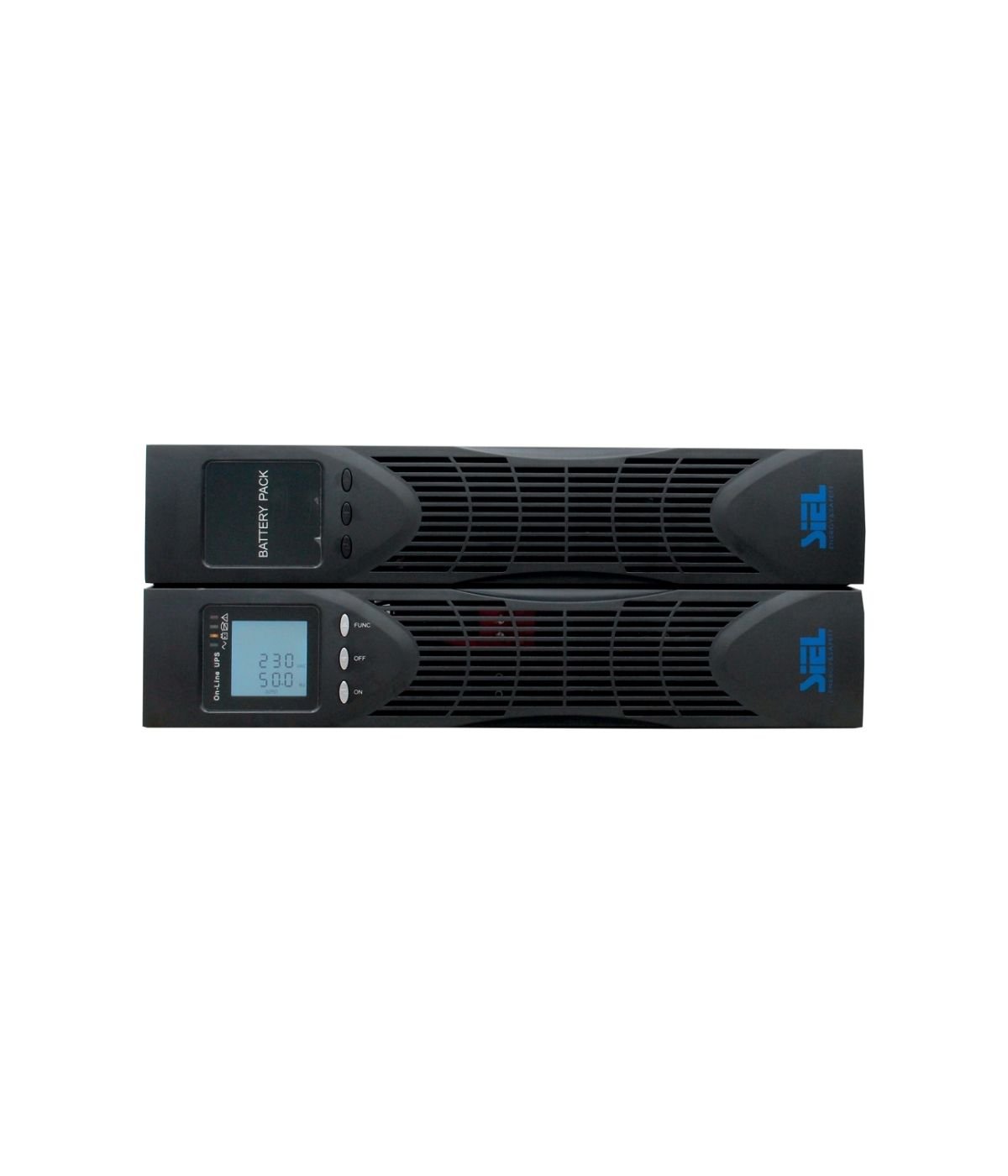
| Greenpoint 3K | 3 kVA / 3 kW | 8 x IEC C13, 1 x IEC C19 | 72 V, 12 V 9 Ah AGM blocks | 440 x 600 x 86.5 mm (2U) | 29 kg |
| Greenpoint 6K | 6 kVA / 6 kW | 3 x IEC C13, 2 x IEC C19, terminal block | 240 V AGM, or 192 V LiFePO4 option | 440 x 621 x 86.5 mm (2U) | 15.4 kg |
Step 1: Add up what will actually run on the UPS
Sizing starts with a list of everything that must stay on when the power goes, and the real watts each item draws. A plug-in power meter gives you the best figure. If you only have the label on the power supply, treat it as a maximum, because most equipment draws well below its rating in normal use.
Then leave 20 to 30% headroom. A UPS that runs flat out all day runs hotter, gives you less battery time, and leaves no room for the extra PC or camera you will add next year.
A worked example
Say a small accounting firm in Westlands wants to protect its office network. These are example figures, so measure your own:
- One file and accounts server: 300 W
- A NAS for backups: 60 W
- Router, firewall and a 24 port switch: 90 W
- Four desktop PCs with monitors at 150 W each: 600 W
- CCTV recorder and cameras: 80 W
That totals 1,130 W. Add 30% headroom and you need about 1,470 W, which rules out the 1K and makes the 2K the minimum. If the firm expects to add more PCs, or wants a longer battery time from the same unit, the 3K is the safer buy. This is why the 3kVA online UPS is the size we quote most often for small offices: it covers a server, the network and a handful of workstations with room to grow.
What usually fits each size
- 1kVA (1 kW): one workstation and monitor, a till with its network gear, a router and switch with a small CCTV recorder, or a single lab or reception computer in a clinic.
- 2kVA (2 kW): a small server or NAS with the office network, or a few workstations in a branch office.
- 3kVA (3 kW): a server, storage and networking with several workstations, or a busier network cabinet. The C19 socket takes higher draw equipment such as larger servers.
- 6kVA (6 kW): a full rack or a small server room, or a whole floor of workstations fed from a distribution board.
Above 6 kW, look at our guide to the 10kVA online UPS options, where the Greenpoint 10K and the SIEL three-phase ranges take over.
Step 2: Keep laser printers and kettles off the UPS
Some loads draw a large surge of current when they heat up or start, and they are the usual reason a small UPS overloads. APC, for example, does not recommend protecting laser printers with a UPS, because their high current draw causes voltage dips and drains the battery, and advises a separate circuit and surge protection instead. The same thinking applies to photocopiers, kettles, microwaves, heaters and anything with a motor or compressor. Keep the UPS for the equipment that holds your data and keeps your business running.
Step 3: Be realistic about battery time
This is where most small UPS purchases go wrong. The 1K, 2K and 3K run on strings of 12 V 9 Ah AGM blocks, and you can work out the stored energy yourself. The 3K’s 72 V string holds about 648 Wh on paper (72 V x 9 Ah). At a full 3 kW load, that is at most about 13 minutes, even if every watt-hour could be used.
In practice you get less. Lead acid batteries deliver less of their rated capacity the faster you drain them, an effect known as Peukert’s law. In one worked example, a 100 Ah lead acid battery gives the equivalent of only 71.9 Ah at a heavy load. Batteries also lose capacity with age, and an industry paper published by Vertiv notes that UPS batteries are treated as end of life at 80% of rated capacity. A runtime that looks fine on day one can be half that a few years later.
Compare that with the 3.23 hour average outage in the EPRA figures above. Planned maintenance is longer still. Kenya Power posts its planned interruption notices on its X account, and the list for 10 September 2026 had most areas, including parts of Karen and Industrial Area in Nairobi, off from 9 am to 5 pm. No small UPS is built to carry an office for a full working day. So decide which plan fits you:
- With a generator: the UPS only needs to bridge the gap until the generator starts and settles. A few minutes of battery is enough, and the internal batteries usually cover it.
- Without a generator, short outages only: add external battery boxes. Each Greenpoint takes up to four. On the 3K, each box holds 12 more blocks, about 1,296 Wh on paper, so four boxes multiply the stored energy several times over.
- Without a generator, long outages: size the battery for a clean shutdown of your servers and PCs, and use the UPS’s network connection to trigger it automatically.
The 6K is built for longer runtime from the start. It runs a 240 V string of 20 AGM blocks in a 3U battery box, about 2,160 Wh per box on paper, with up to four boxes. It also takes an optional lithium (LiFePO4) battery at 192 V. Note its weight: 15.4 kg for the UPS itself, so plan the space and weight for its battery boxes too. Our guide to what a 6kVA UPS can run works through a full example.
Step 4: Check your sockets and your circuit
The Greenpoint has IEC outlets, not the three pin sockets on your wall. The C13 outlet takes the standard IEC lead used by most PCs and servers and is rated at 10 A, and the C19 is its larger 16 A cousin, under the IEC 60320 standard. Servers, switches and most desktop PCs take a removable IEC lead, so a C13 to C14 cable connects them straight to the UPS. Anything with a fixed three pin plug needs an IEC power strip on the UPS output.
Then look at the supply side. Kenya uses the Type G three pin socket, rated up to 13 A. A UPS carrying 3 kW at 230 V draws about 13 A, which is the full rating of a wall socket before the UPS even charges its batteries. For a 3K that will run near its limit, have an electrician give it a dedicated circuit. The 6K, at about 26 A for a full 6 kW, goes beyond any single socket, and its terminal block output should be wired in by a qualified electrician.
Step 5: Plan for heat and monitoring
SIEL rates the Greenpoint for 0 to 40 °C and up to 95% humidity without condensation, but the batteries last longest in a cool room. That matters in a Mombasa shop or a store room with no air conditioning. Our rack mount UPS guide covers battery temperature and rack depth in more detail.
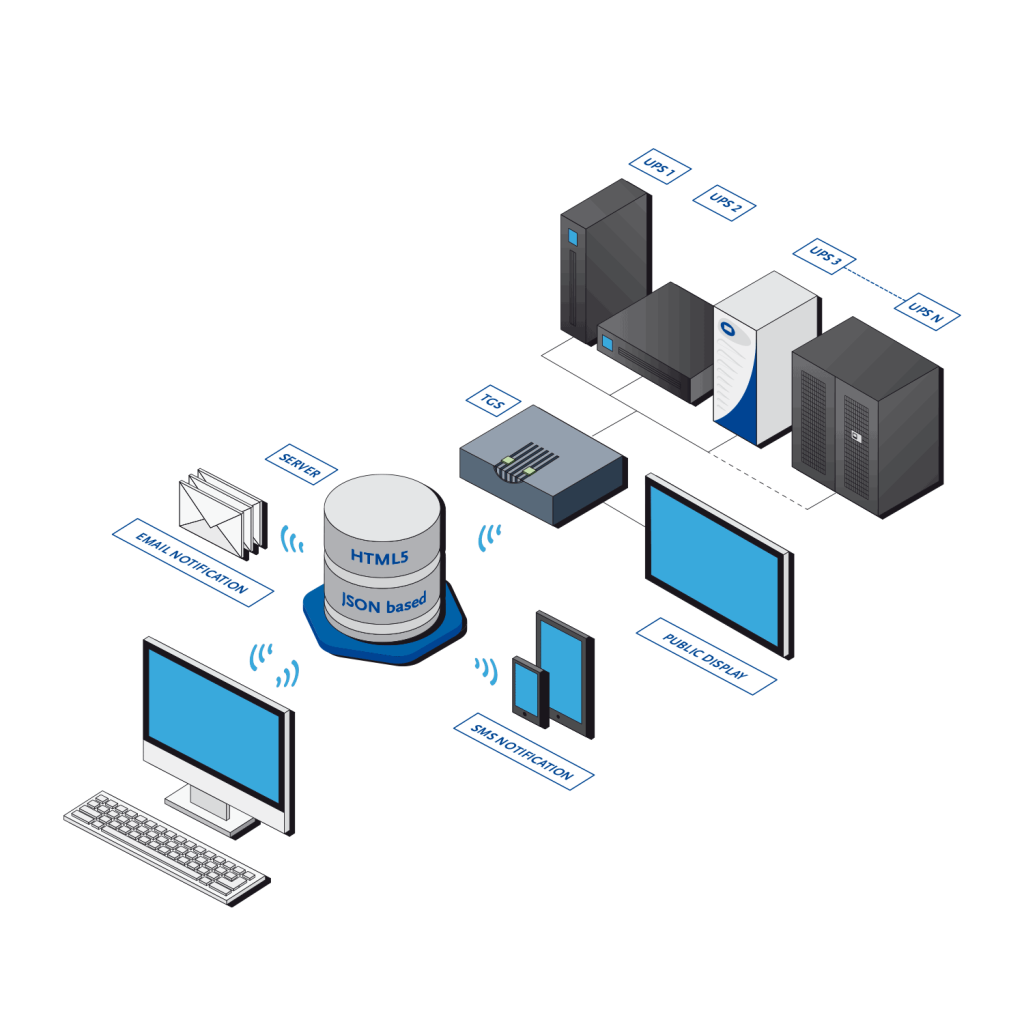
Every model has RS232, USB, relay contacts, an emergency power off input and SNMP. That means the UPS can alert you over the network when the power fails and tell your servers to shut down cleanly before the battery runs out, even when nobody is in the office.
Which one should you buy?
- Choose the Greenpoint 1K if your real load is under about 700 W: a till, a single workstation, or a network cabinet.
- Choose the Greenpoint 2K if it is under about 1,400 W: a small server with the network and a few PCs.
- Choose the Greenpoint 3K if it is under about 2,100 W, or if you want the C19 socket and room to grow.
- Choose the Greenpoint 6K if it is under about 4,200 W, if you need long runtime, or if you want a lithium battery option.
These cut-offs leave about 30% headroom. If you sit near the line, go one size up.
Getting a quote
Encom Digital is SIEL’s only retailer in Kenya and East Africa. Every Greenpoint is supplied on order and configured to your load and runtime, so pricing is by quote, and our prices are quoted excluding VAT. Send us your equipment list or measured load in watts, the runtime you want, whether you have a generator, and whether the UPS goes in a rack or stands on the floor. Request a quote on WhatsApp on +254 714 962 072, or Email us. You can also browse the full SIEL UPS range on the shop.
Frequently asked questions
What can a 3kVA online UPS run?
The SIEL Greenpoint 3K delivers up to 3 kW. With 30% headroom, that suits a real load of about 2,100 W, which typically covers a server, storage, networking and several workstations.
Is 3kVA the same as 3kW?
Only when the UPS has an output power factor of 1. The Greenpoint does, so its 3 kVA model delivers 3 kW. Many other units deliver 80 or 90% of their kVA rating in watts.
How long will a 3kVA UPS last during a blackout?
It depends on your load and batteries. The 3K’s internal 72 V string holds about 648 Wh on paper, so at full load it lasts at most about 13 minutes and less in practice. External battery boxes extend this, up to four per UPS.
Is a 1kVA online UPS enough for one computer?
Yes, for most desktop workstations with a monitor, and it can also carry a router, switch or till. The Greenpoint 1K delivers up to 1 kW.
Should I choose a 2kVA or a 3kVA UPS?
Add up your real load and add 20 to 30% headroom. If the result is under about 1,400 W, the 2K works. Above that, or if you plan to add equipment, choose the 3K.
When do I need a 6kVA UPS?
When your real load is above about 2,100 W, when you need long battery runtime, or when you want a lithium battery option. The 6K takes LiFePO4 at 192 V as an option.
Why buy an online UPS instead of a line-interactive one?
An online UPS feeds your equipment from its inverter all the time, so it filters out sags, spikes and frequency swings and has no switchover gap. It also copes better with generator power, where line-interactive units can keep dropping to battery.
Can I plug a laser printer into my UPS?
It is best not to. Laser printers draw large surges of current that can overload a UPS and drain its battery. Give them their own circuit and surge protection instead.
What sockets do the Greenpoint 1K to 6K have?
The 1K and 2K have 8 IEC C13 outlets. The 3K has 8 C13 and 1 C19. The 6K has 3 C13, 2 C19 and a terminal block.
Can I plug a 3kVA UPS into a normal wall socket?
A Kenyan Type G socket is rated up to 13 A, and a 3 kW load at 230 V draws about 13 A. If your 3K will run near full load, have an electrician fit a dedicated circuit.
Does a 6kVA UPS need an electrician?
Yes. A full 6 kW load draws about 26 A, beyond any single wall socket, and the 6K’s terminal block output should be wired by a qualified electrician.
Do these UPS units work with a generator?
Yes. SIEL lists every Greenpoint as generator compatible, and the input accepts 110 to 300 V.
Can the Greenpoint stand on the floor, or does it need a rack?
Either. All four models convert between rack and tower mounting and take 2U in a rack.
Can the UPS shut down my server automatically?
Yes. Each model has SNMP, USB, RS232 and relay contacts, so monitoring software can alert you and shut your equipment down cleanly before the battery runs out.
How much does a 3kVA online UPS cost in Kenya?
SIEL Greenpoint units are supplied on order and priced by quote, because the battery setup changes the price. Our prices are quoted excluding VAT. Send us your load and runtime on WhatsApp or by email for a quote.