

Kenya Power customers sat through an average of 8.39 hours of outages a month in the first half of the 2025/26 financial year, spread over 3.52 interruptions a month against EPRA’s limit of 1.10, according to EPRA figures reported by People Daily. Then there are the big ones. On the night of 29 July 2026, Nairobi, the Coast, Mt Kenya and parts of the Central Rift went dark for hours.
Outages are only half the story, though. Every IT manager in Kenya has seen what happens around them: the lights dim before stima imeenda, the voltage jumps when it comes back, the generator kicks in with a wobbly frequency. An online double conversion UPS is the type built to deal with all of that, including the blackout itself. This guide explains how it works, how it differs from the cheaper offline and line-interactive units, and which sizes make sense for your site.

How an online double conversion UPS works
The name describes exactly what happens. Power from the wall goes into a rectifier, which turns AC into DC. That DC keeps the batteries charged and feeds an inverter, which builds brand new AC for your equipment. Two conversions, all the time, whether the mains is clean or not.
Because the load always runs from the inverter, there is nothing to switch over when the mains fails. The batteries are already sitting on the DC side, so they simply carry on feeding the inverter. Fuji Electric puts it plainly: an online UPS has no change over or transfer time, and the mains voltage and frequency are isolated from the load.
There is also a static bypass. If the UPS develops a fault or is badly overloaded, it can pass the mains straight through so the load stays up. On the SIEL Greenpoint, for example, the bypass only accepts mains between 176 and 264 V, so the UPS will not hand your servers a supply that is far out of range.
Offline, line-interactive and online: what each one protects against
The international UPS standard, IEC 62040-3, sorts UPS systems into three classes by how much the output depends on the input. VFD units are offline, VI units are line-interactive and VFI units are online double conversion. Here is how they compare on the problems Kenyan sites actually face, based on Riello UPS’s comparison of the three types.
| Problem on the supply | Offline (VFD) | Line-interactive (VI) | Online double conversion (VFI) |
|---|---|---|---|
| Complete outage | Yes, after a 4 to 8 ms break | Yes, after a short break | Yes, with no break |
| Spikes and electrical noise | Yes | Yes | Yes |
| Sags and brownouts | No | Yes | Yes |
| Surges | No | Yes | Yes |
| Harmonics | No | No | Yes |
| Frequency variation | No | No | Yes |
An offline UPS lets raw mains through until it fails, then switches to battery. A line-interactive UPS adds voltage regulation, so it can ride through dips and surges without touching the battery. Only the online type rebuilds the power from scratch, which is why it is the one that handles harmonics and frequency swings as well.
What VFI-SS-111 on a spec sheet tells you
Good online UPS systems carry a full code such as VFI-SS-111. VFI is the online class, SS means a sine wave output in every mode, and 111 is the best score for how steady the output stays when the UPS changes mode or the load jumps. VFI-SS-111 is the highest classification a UPS can carry, and every SIEL range we supply is rated to it. Our guide to the SIEL UPS ranges goes into the code in more detail.
Why online double conversion suits Kenyan power
It works properly with a generator
Many Kenyan businesses with a server room also run a standby generator. A generator’s frequency drifts as the load changes, and offline and line-interactive units treat out of range frequency as a fault and drop to battery. UPS Systems, a UK standby power specialist, says it is almost impossible to make either type work with a standby generator, while for an online UPS the input frequency is of little concern. If your UPS keeps beeping and draining its batteries every time the genset is running, the topology is usually the reason.
It copes with low and unstable voltage
Sites on long rural lines can see voltage sag well below the nominal level. Because an online UPS rebuilds the output, it can accept a wide input range without using the battery. The SIEL Greenpoint accepts 110 to 300 V input and still delivers a pure sine wave at 208, 220, 230 or 240 V, with output voltage held within 3% in steady state, courtesy of SIEL’s specifications.
There is no gap when stima imeenda
A 4 to 8 ms break may be fine for a desktop PC, but there is no reason to take that chance with servers, storage and network switches. With an online UPS the load never sees the outage at all. That also holds for planned maintenance cuts, which Kenya Power posts on its official X account: the UPS carries the load until your generator is up or the mains returns.
Who needs an online UPS, and who does not
An online double conversion UPS is the right choice when downtime or bad power costs real money:
- Servers, storage and core network switches in an office or branch
- Banking halls, SACCO offices and retail tills that must keep transacting
- Clinic and lab systems, CCTV recorders and access control
- Any site that runs on a generator during outages
- Data rooms, factory control systems and telecom equipment, where the three-phase models come in
For a single home PC, a Wi-Fi router or a TV, an online UPS is usually more than you need. If what you want is a few hours of power for the house during an outage, a battery unit makes more sense. Our guide to portable power stations in Kenya covers that side.
Online double conversion UPS sizes we supply
Every unit below is a SIEL online double conversion UPS with an output power factor of 1, so the kVA and kW ratings are the same. A 3 kVA unit carries a full 3 kW. Our 3kVA buying guide shows what that size runs in a typical Kenyan office.
| Size | Model | Phase | Form | Output sockets |
|---|---|---|---|---|
| 1 kVA / 1 kW | SIEL Greenpoint 1K | Single | Rack or tower, 2U | 8 x IEC C13 |
| 2 kVA / 2 kW | SIEL Greenpoint 2K | Single | Rack or tower, 2U | 8 x IEC C13 |
| 3 kVA / 3 kW | SIEL Greenpoint 3K | Single | Rack or tower, 2U | 8 x IEC C13 and 1 x IEC C19 |
| 6 kVA / 6 kW | SIEL Greenpoint 6K | Single | Rack or tower, 2U | 3 x C13, 2 x C19 and terminal block |
| 10 kVA / 10 kW | SIEL Greenpoint 10K | Single | Rack or tower, 2U | 3 x C13, 2 x C19 and terminal block |
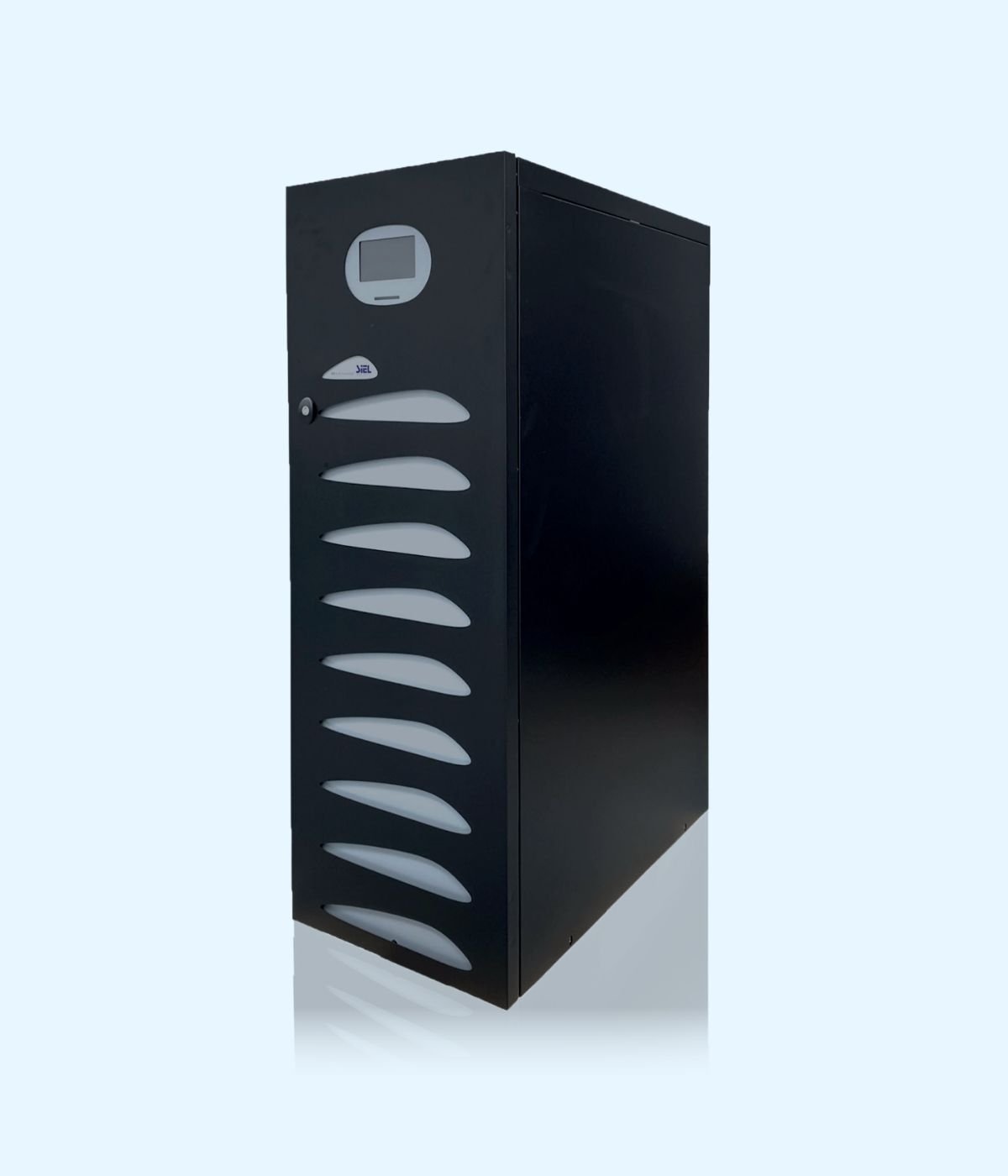
| 10 to 200 kVA | SIEL Safepower S | Three (10K and 20K also 3/1 or 1/1) | Floor tower | Hardwired |
| 10 to 200 kVA | SIEL Safepower Evo HF | Three (10K and 20K also 3/1 or 1/1) | Floor tower | Hardwired |
As a rough guide, the 1K and 2K suit a single server or a small network cabinet, the 3K covers a few servers with switches, and the 6K and 10K handle a full rack or a small server room. Above 10 kW, or on a three-phase supply, you move to Safepower S or Safepower Evo HF. For rack depth, runtime and cooling on the single-phase models, see our rack mount UPS sizing guide.
What to check on an online UPS spec sheet
Many units in the Kenyan market are sold as “online”. These are the numbers that separate a good one from a weak one, with SIEL’s figures for comparison:
- Output power factor. A unit rated 0.8 only gives you 2.4 kW from 3 kVA. All three SIEL ranges are rated at 1.
- Output distortion (THDv). Lower is cleaner. Greenpoint is rated at 1% or less on linear loads and 3% or less on non-linear loads such as server power supplies.
- Input power factor and input distortion (THDi). A high input power factor and low THDi mean the UPS is kind to your generator and wiring. Greenpoint runs at 0.99 input power factor, and Safepower S and Evo HF keep THDi at 3% or less.
- Overload tolerance. Safepower Evo HF runs at 110% load for 60 minutes and 125% for 10 minutes, which gives you time to react if someone plugs in something they should not.
- Cold start. Lets the UPS start from batteries when there is no mains at all. All three SIEL ranges have it.
- Battery expansion. Greenpoint takes up to four external battery boxes, and the 6K and 10K can take lithium (LiFePO4) batteries instead of AGM.
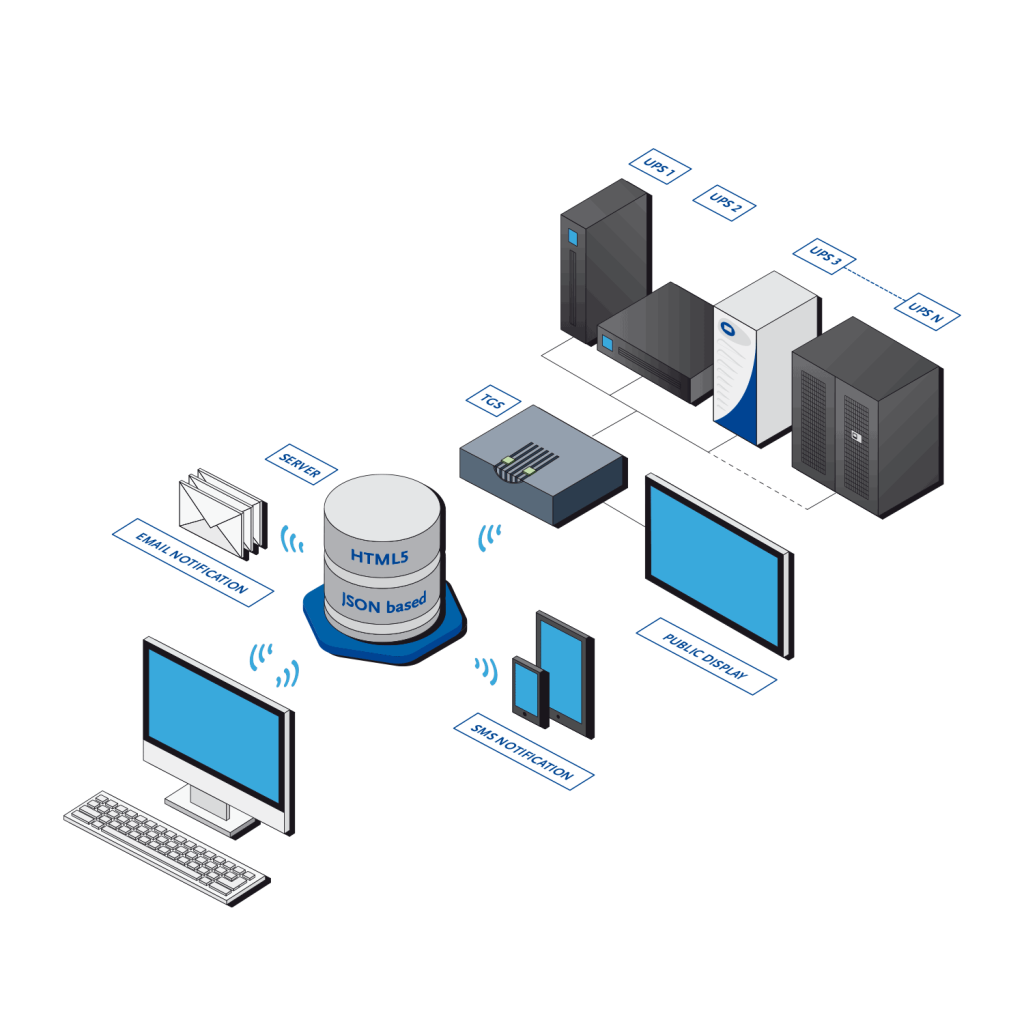
- Monitoring. SNMP lets the UPS report to your network and shut servers down cleanly before the batteries run out. Greenpoint has SNMP, RS232, USB and relay contacts as standard.
A word on ECO mode
Most online UPS systems, SIEL’s included, offer an ECO or high efficiency mode. In traditional ECO mode the UPS sends the load through the bypass instead of the double conversion path. That lifts efficiency to around 98 to 99%, but the load is exposed to raw utility mains, and there is a break of a few milliseconds when it transfers back. On a clean, stable supply that trade can make sense. On a site with frequent dips and generator changeovers, leave the UPS in online mode. SIEL rates Safepower S at up to 96.5% and Evo HF at up to 96.6% efficiency in full online mode, so the cost of staying protected is small.
Sizing it in three steps
- Add up the real load in kW. Use the measured or rated running power of each server, switch and storage unit, not the size of the power supply. Leave about 20 to 30% headroom for growth.
- Decide the runtime. If a generator takes over within a minute or two, a few minutes of battery is enough. With no generator, plan extra battery boxes or cabinets for the time you need to finish work or shut down cleanly.
- Check the generator size. The generator has to carry the UPS, recharge its batteries and cover its losses. In one worked example, UPS Systems shows a 100 kVA UPS needing a generator 72.5% larger than the UPS. Ask your generator supplier to confirm for your site.
Getting an online double conversion UPS from Encom
Encom Digital is the only retailer of SIEL UPS systems in Kenya and East Africa. Every unit is supplied on order and quoted per project, because the price depends on the model, the batteries and the runtime you need. Our prices are quoted excluding VAT. Send us your load in kW or a list of the equipment, your supply type, the runtime you want and whether you run a generator, and we will recommend the right model. Request a quote on WhatsApp on +254 714 962 072, or Email us. You can browse the full SIEL UPS range on the shop.
Frequently asked questions
What is an online double conversion UPS?
It is a UPS that turns incoming AC into DC and then back into clean AC all the time. Your equipment always runs from the inverter, never directly from the mains, so there is no break when power fails.
Is an online UPS the same as an online double conversion UPS?
In everyday use, yes. Both describe the VFI class under IEC 62040-3, where output voltage and frequency are independent of the input.
What is the transfer time of an online UPS?
Zero. The batteries already sit on the DC side feeding the inverter, so nothing switches over when the mains fails. An offline UPS has a break of around 4 to 8 ms.
What is the difference between a line-interactive and an online UPS?
A line-interactive UPS regulates voltage but still passes mains frequency and harmonics through, and has a short break when it switches to battery. An online UPS rebuilds the power completely, so it handles frequency variation and harmonics as well, with no break.
Does an online UPS work with a generator?
Yes, and it is the best type for it. Online UPS systems are far less affected by generator frequency variation, which often pushes offline and line-interactive units onto battery. SIEL lists the Greenpoint as generator compatible.
What size online UPS do I need for my server rack?
Add up the running power of the equipment in kW and leave about 20 to 30% headroom. With SIEL’s power factor of 1, that kW figure maps straight onto the kVA rating, from the 1 kVA Greenpoint up to the 10 kVA Greenpoint for a single-phase rack.
Which sizes of online UPS does Encom supply?
Single-phase SIEL Greenpoint in 1, 2, 3, 6 and 10 kVA, and three-phase SIEL Safepower S and Safepower Evo HF from 10 to 200 kVA.
How much does an online double conversion UPS cost in Kenya?
SIEL units are supplied on order and quoted per project, because the price depends on the model, batteries and runtime. Encom quotes prices excluding VAT. Send us your load and runtime for a quote.
What does VFI-SS-111 mean?
It is the full IEC 62040-3 classification. VFI is the online class, SS means sine wave output, and 111 is the best rating for output stability during mode changes and load steps. It is the highest classification a UPS can carry.
Should I use ECO mode on my online UPS?
Only on a clean, stable supply. ECO mode raises efficiency by sending the load through the bypass, but the load then sees raw mains and there is a brief break on transfer. On sites with frequent dips or generator changeovers, stay in online mode.
Can I add more battery runtime later?
On the Greenpoint, yes. It takes up to four external battery boxes per UPS, and the 6K and 10K can use lithium (LiFePO4) batteries. The larger three-phase models use external battery cabinets sized to your runtime.
Do I need an online UPS for my home?
Usually not. For a home PC, router or TV, a smaller UPS or a portable power station is enough. Online double conversion is for servers, network equipment and business systems that cannot afford a break or bad power.
Can I monitor the UPS over my network?
Yes. Greenpoint has SNMP, RS232, USB and relay contacts as standard. Safepower S adds LAN, RS485 and Modbus, and Evo HF supports SNMP, RS232 and RS485 Modbus.