

On Thursday, 10 September 2026, Kenya Power listed a planned interruption from 9 am to 5 pm for part of Enterprise Road in Nairobi’s Industrial Area. A full shift without grid power is routine for many Kenyan plants. EPRA’s latest figures put the national average at 8.39 hours of outages a month against a target of 1.5 hours, and the same report notes that outages in Nairobi’s industrial areas disrupt production schedules and damage equipment.
Your generator covers the long outages. What it cannot do is stop a PLC from rebooting in the seconds before it starts and takes the load, or stop a SCADA server from crashing mid write. That gap is the job of an industrial UPS. This guide is for plant engineers, maintenance managers and facilities teams. It covers what to put on the UPS, what to leave on the generator, how to size it, and how the two SIEL three-phase ranges we supply fit a factory, a processing plant or a utility site.
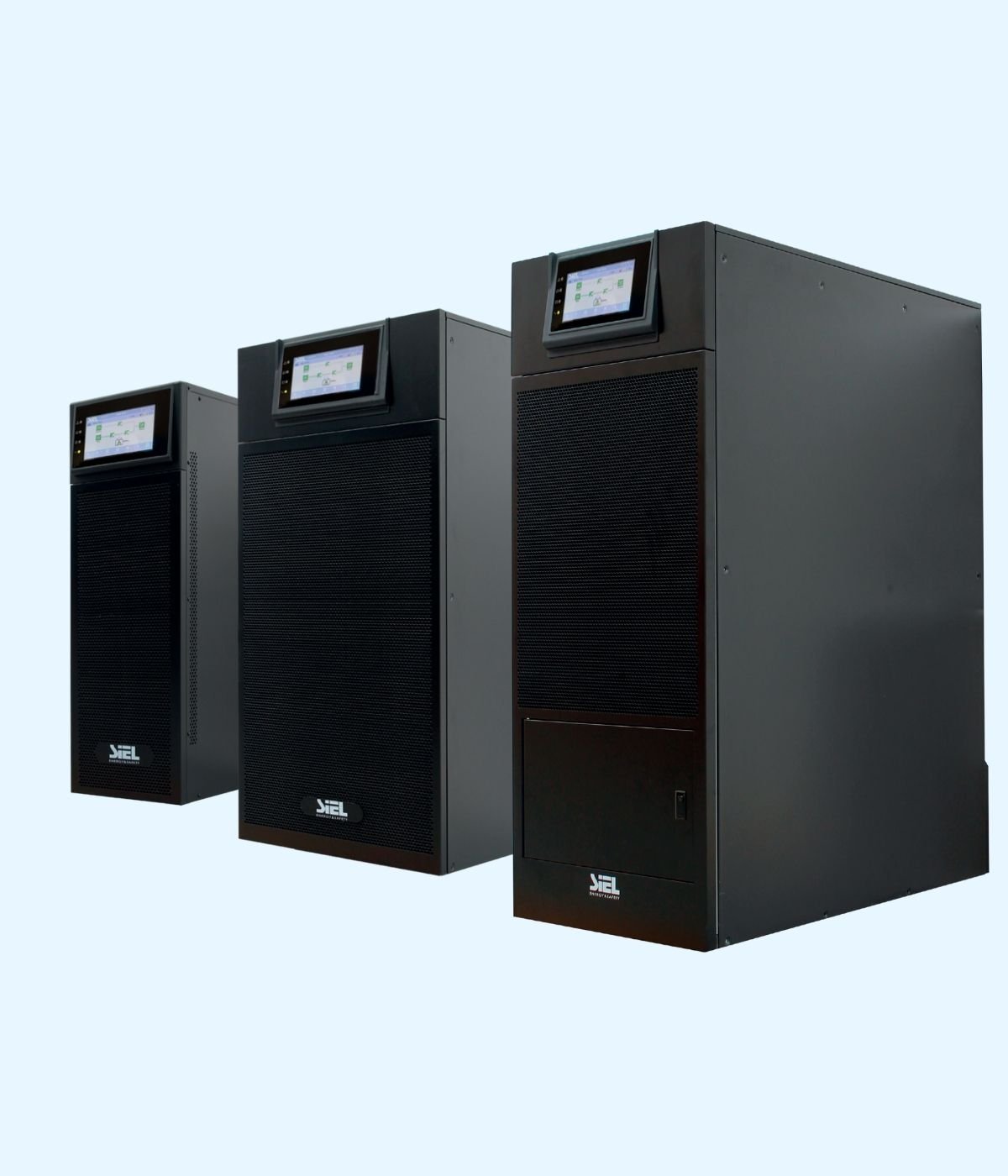
What makes a UPS “industrial”
An office UPS protects data. An industrial UPS protects a process, and sometimes people. Schneider Electric’s guide to choosing an industrial UPS puts uptime and safety first, then the environment the unit will live in: humidity, vibration, temperature and chemical or saline exposure. The electrical side matters too: phase, voltage, frequency, power factor, battery type and whether you need redundancy.
In practice, a UPS for a plant needs to do four things well:
- Run with no break. Control systems should sit on an online double conversion UPS, so they never see the switchover gap of an offline unit. We explain how that works in our guide to online double conversion UPS in Kenya.
- Carry awkward loads. Control transformers, solenoids and drive electronics are not as tidy as a row of servers. SIEL rates both ranges to supply inductive and capacitive loads at their full kW rating.
- Take short overloads without dropping the load. A contactor pulling in or a transformer energising draws a burst of current. The UPS has to ride that out.
- Talk to your control system. Plant engineers need UPS alarms in the SCADA or BMS, not on a screen in a locked room.
SIEL builds its Safepower S range for exactly this, describing it as suited to industrial installations as well as critical IT. Both Safepower S and Safepower Evo HF are rated VFI-SS-111 under IEC EN 62040-3, the top classification for an online UPS, and both have an output power factor of 1, so a 20 kVA unit delivers a full 20 kW.
What to put on the UPS, and what to leave on the generator
The most common mistake we see on industrial sites is trying to put everything on the UPS. A UPS should protect the brains of the plant, not the muscle.
Put these on the UPS
- PLCs, I/O racks and control panels
- SCADA servers, HMI stations and historians
- The plant network: switches, firewalls and wireless access points
- Quality lab instruments and analysers that lose a test run if power blips
- The control electronics of variable speed drives, not the drives’ motor power
- CCTV, access control, fire panels and emergency escape lighting
- Weighbridge terminals, dispatch PCs and the ERP workstations that keep trucks moving
Leave these on the generator
Large motors, air compressors, cold room and chiller compressors, pumps, heaters, ovens and welders. These loads either draw a lot of steady power or a big burst when they start. Small motors and inductive loads can pull 3 to 6 times their running current for 100 to 500 milliseconds as they start. Bigger machines are harder still.
Compare that with what the UPS can take. SIEL rates the Safepower S to carry 110% of its rating for 60 minutes, 125% for 10 minutes and 150% for 1 minute. Above 150%, it moves the load to bypass. That is fine when the mains is healthy, but during an outage there is no mains to bypass to. Keep motor loads on the generator, which is built to handle them.
The same goes for laser printers in the dispatch office. Schneider Electric’s APC team does not recommend protecting laser printers with a UPS, because of their high power draw.
Sizing an industrial UPS: a worked example
A sound method for control loads is to add up the steady load, list the largest single inrush separately, and then apply a margin of 1.25 as a baseline, not an upper limit. Count inductive items such as control transformers in VA, not watts, because their power factor is below 1.
Take a hypothetical food processing plant in Athi River with two packing lines. The control loads it wants on the UPS are:
| Load | Measured running load |
|---|---|
| PLCs and control panels for two packing lines | 1.6 kW |
| SCADA server, two HMI stations and the plant network | 2.4 kW |
| Quality lab instruments | 2.0 kW |
| CCTV and access control | 0.8 kW |
| Emergency escape lighting | 2.2 kW |
| Total | 9.0 kW |
9.0 kW multiplied by 1.25 gives 11.25 kW. A 10 kVA unit is too small. A SIEL Safepower S 20K or Safepower Evo HF 20K carries the load at about 56% of its rating, leaves room for a third line and gives longer battery time than a unit running near its limit. The filling machines, the air compressor and the cold room stay on the generator. Our comparison of the Safepower S 20K and Evo HF 20K helps you choose between them.
On a three-phase UPS, also check the load on each phase, not just the total. Our three-phase UPS sizing guide walks through that, along with sizing the generator to suit the UPS.
How much runtime does a plant need?
With a generator on site, the UPS only has to bridge the start and changeover, plus a safety margin in case the generator fails to start on the first attempt. A common target is at least 15 minutes at full load. That gives your team time to start the generator by hand, or to shut the process down in order if they cannot.
Built for the plant room
Factory electrical rooms are hotter and dustier than server rooms. Plan for that from day one. If you are protecting a server room instead, our UPS guide for data centres covers redundancy and batteries.
- Temperature and humidity. SIEL rates both ranges for 0 to 40 °C and 0 to 95% humidity without condensation. Batteries last longest well below the top of that range, so ventilate the room or give it air conditioning.
- Enclosure rating. Both ranges come as IP20 as standard. Under EN 60529, a first digit of 2 means protection against objects larger than 12.5 mm, and a second digit of 0 means no protection against water. The UPS belongs in a clean, dry electrical room, not on the production floor. Safepower Evo HF is also available as IP21 or IP31 on request, which adds protection against dripping water and, for IP31, against objects larger than 2.5 mm.
- Battery choice. Lithium batteries last around 10 years, against 3 to 5 for VRLA, and cope better with heat. Safepower Evo HF takes standard VRLA batteries, with lithium (LiFePO4) as an option. That makes it the stronger pick for remote plants, flower farm packhouses and pumping stations where battery replacement visits are costly.
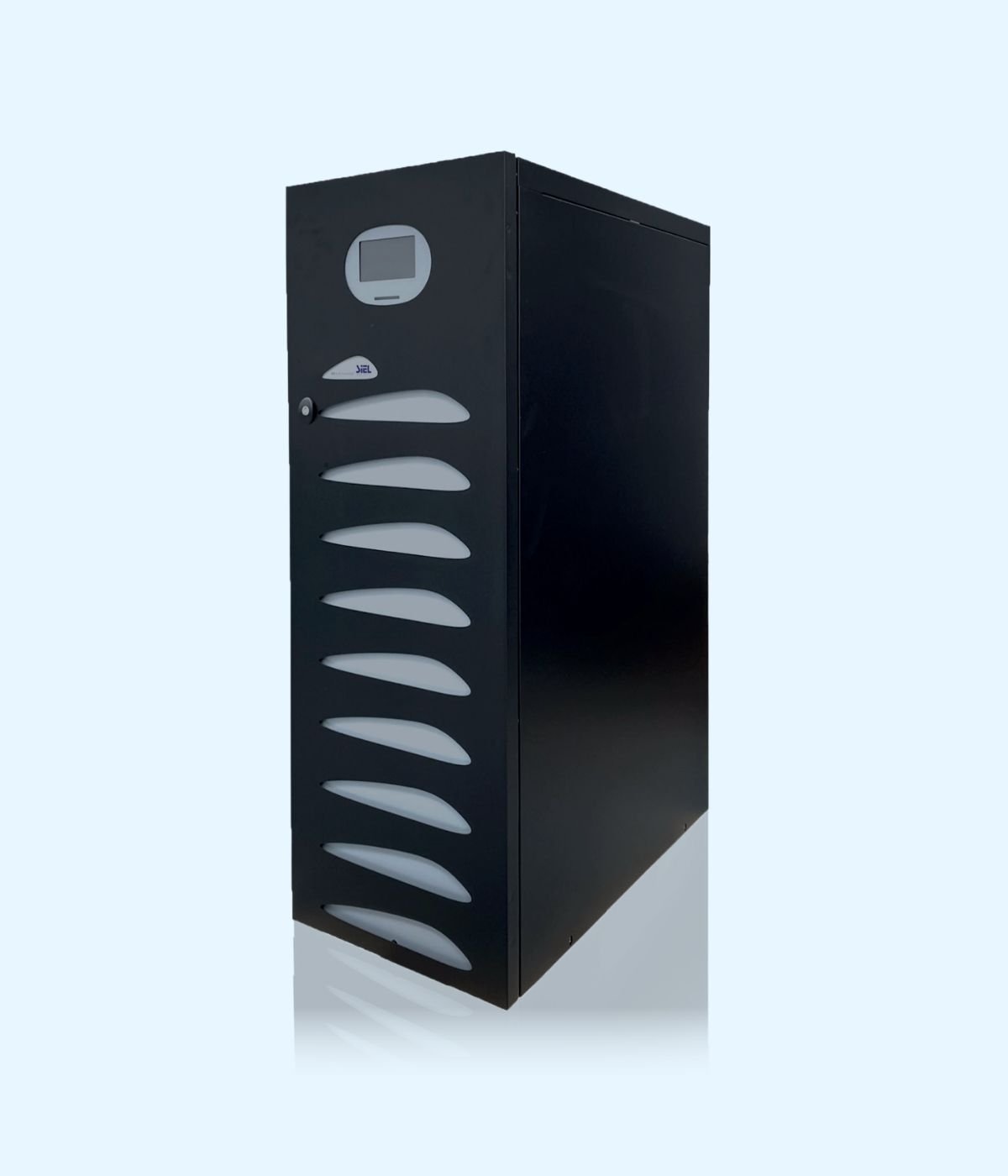
Safety features a plant engineer should check
Backfeed protection
When the mains is isolated, a UPS without proper backfeed protection can push voltage back onto its own input, which your electricians believe is dead. A Queensland mine safety alert found 240 V on the plug pins of a disconnected UPS, and backfeed of 55 V or more on 75% of the models tested. Its advice: check backfeed protection during routine maintenance and always test for dead before working downstream of a UPS. SIEL lists a backfeed protection output on the Safepower S. For Evo HF installations, we confirm the backfeed arrangement in the quote.
Emergency power off and diesel mode
Safepower S has a remote emergency power off (EPO) input, so the UPS output can be cut from the plant’s emergency stop system, and a diesel mode input that tells the UPS when it is running from the generator. Both models also have cold start, so you can bring the UPS up from batteries when the mains is already down.
Emergency lighting
SIEL lists both ranges as compliant with EN 50171, the standard for central power supply systems for emergency escape lighting and other safety equipment. A single UPS can therefore cover both the control system and the escape lighting circuits, which is useful in large warehouses and production halls.
Getting UPS alarms into your SCADA
Wire the UPS “on battery” and “low battery” signals as dry contacts to fast digital inputs on the PLC, then use Modbus for the rest of the status and measurement data. That way the PLC can start a controlled shutdown before the batteries run out, and operators see the alarm on their own screens.
- Safepower S: RS232, RS485, LAN, Modbus, dry contacts and two intelligent slots, with a 7 inch graphic touchscreen on the unit.
- Safepower Evo HF: SNMP, RS232 and RS485 Modbus.

Generators, harmonics and redundancy
Both ranges draw input current distortion (THDi) of 3% or less, with an input power factor of 0.99 at full load. A clean input like this is easier on your generator and on the rest of the plant’s supply. Safepower S also accepts an input of 208 to 478 V and 40 to 70 Hz, so it stays off battery while a generator settles or when the supply sags at the end of a long rural line.
For redundancy, guidance for control systems is N+1 as a minimum for process control and 2N for safety systems. N+1 means one more UPS than the load needs, so one unit can fail or be serviced without dropping the load. Safepower S runs up to 4 units in parallel and Safepower Evo HF up to 8, which also lets you start with one unit and add capacity as the plant grows.
Safepower S or Safepower Evo HF for an industrial site?
| Feature | Safepower S | Safepower Evo HF |
|---|---|---|
| Sizes | 10, 20, 30, 40, 60, 80, 120, 150 and 200 kVA | 10, 20, 30, 40, 60, 80, 100, 120, 160 and 200 kVA |
| Online efficiency | Up to 96.5% | Up to 96.6% (10K to 60K), up to 96.2% (80K to 200K) |
| Overload | 110% for 60 min, 125% for 10 min, 150% for 1 min | 103% with no time limit, 110% for 60 min, 125% for 10 min, 150% for 1 min, 200% for 0.5 s |
| Output distortion, non-linear load | 3% or less | 1.5% or less |
| Enclosure | IP20 | IP20, IP21 or IP31 optional |
| Batteries | Internal space on 10K to 30K, external cabinets above | VRLA standard, LiFePO4 optional; internal space on 10K to 60K |
| Parallel units | Up to 4 | Up to 8 |
| Plant safety inputs | Backfeed protection output, EPO input, diesel mode input | Confirmed per installation |
| Monitoring | RS232, RS485, LAN, Modbus, dry contacts | SNMP, RS232, RS485 Modbus |
Choose Safepower S when you want built-in plant safety inputs, a touchscreen for operators on site and a compact transformer-free cabinet. It suits most factories, warehouses and processing plants with a generator on site.
Choose Safepower Evo HF when you want lithium batteries, a cleaner output for sensitive lab or drive electronics, more room to grow through parallel units, or a higher enclosure rating. It suits remote sites, pharmaceutical and lab environments, and plants planning to expand.
The 10K and 20K models of both ranges also come as 3/1 (three-phase in, single-phase out) or 1/1, which helps when the control loads are single-phase but the building supply is three-phase.
SIEL industrial UPS models in Kenya
- Safepower S: 10K, 20K, 30K, 40K, 60K, 80K, 120K, 150K and 200K
- Safepower Evo HF: 10K, 20K, 30K, 40K, 60K, 80K, 100K, 120K, 160K and 200K
For an overview of all three SIEL ranges, including the single-phase Greenpoint for smaller panels and network cabinets, see our SIEL UPS guide or browse the SIEL UPS range.
Getting a quote for an industrial UPS
Encom Digital is SIEL’s only retailer in Kenya and East Africa. Every unit is supplied on order and quoted per project, and our prices are quoted excluding VAT. To quote quickly, send us your list of control loads (or measured kW), your supply type, the runtime you need, your generator size and the conditions in the room where the UPS will sit.
Request a quote on WhatsApp on +254 714 962 072, or Email us and we will come back with the right model, battery setup and parallel arrangement for your plant. You can also visit us at Rehema House, 4th Floor, Standard Street, Nairobi.
Frequently asked questions
What is an industrial UPS?
A UPS chosen to protect a process rather than just data. It keeps control systems, SCADA, instruments and safety circuits running through outages and voltage dips, and it is selected with the plant environment, load types and safety needs in mind.
Which SIEL UPS ranges suit industrial sites?
Safepower S and Safepower Evo HF, both three-phase online double conversion UPS systems from 10 to 200 kVA. SIEL describes the Safepower S as suited to industrial installations as well as critical IT.
Can I run motors and compressors on a UPS?
Large motors, compressors, pumps and heaters should stay on the generator. Their starting current can push the UPS past its overload limit, and during an outage there is no mains to bypass to. Put control systems on the UPS instead.
How do I size an industrial UPS?
Add up the measured running load of everything going on the UPS, count inductive items in VA, list the largest single inrush separately, then apply a margin of at least 1.25. Check the load on each phase as well as the total.
How much overload can a SIEL Safepower S take?
SIEL rates it for 110% for 60 minutes, 125% for 10 minutes and 150% for 1 minute. Above 150%, it transfers the load to bypass.
How long should an industrial UPS run on battery?
With a generator on site, a common target is at least 15 minutes at full load. That covers the generator start and gives time for a manual start or a controlled shutdown if it fails.
Can the UPS sit on the factory floor?
Both ranges are IP20 as standard, which gives no protection against water and only keeps out objects larger than 12.5 mm. Install the UPS in a clean, dry, ventilated electrical room. Safepower Evo HF is available as IP21 or IP31 on request.
What temperature can SIEL industrial UPS systems handle?
SIEL rates Safepower S and Safepower Evo HF for 0 to 40 °C at 0 to 95% humidity without condensation. Batteries last longer in a cooler room.
Is there a lithium battery option?
Yes, on the Safepower Evo HF, which takes standard VRLA batteries with LiFePO4 lithium as an option. Lithium batteries typically last around 10 years, against 3 to 5 for VRLA.
What is UPS backfeed protection?
It stops the UPS from pushing voltage back onto its input when the mains is isolated, which protects electricians working on circuits they believe are dead. SIEL lists a backfeed protection output on the Safepower S.
Can the UPS connect to my SCADA or BMS?
Yes. Safepower S offers RS232, RS485, LAN, Modbus and dry contacts. Safepower Evo HF offers SNMP, RS232 and RS485 Modbus. Wire the on battery and low battery signals to the PLC so it can shut the process down in order.
Can one UPS power the emergency escape lighting too?
SIEL lists both ranges as EN 50171 compliant, the standard for central power supply systems for emergency escape lighting, so they can serve those circuits as well as your control loads.
Do I need redundancy?
For process control, N+1 is a sensible minimum, and safety systems often use 2N. Safepower S runs up to 4 units in parallel and Safepower Evo HF up to 8.
Where can I buy a SIEL industrial UPS in Kenya, and how much does it cost?
Encom Digital is SIEL’s only retailer in Kenya and East Africa. Units are supplied on order and quoted per project, excluding VAT. Send us your loads, runtime and site details on WhatsApp or by email for a quote.