

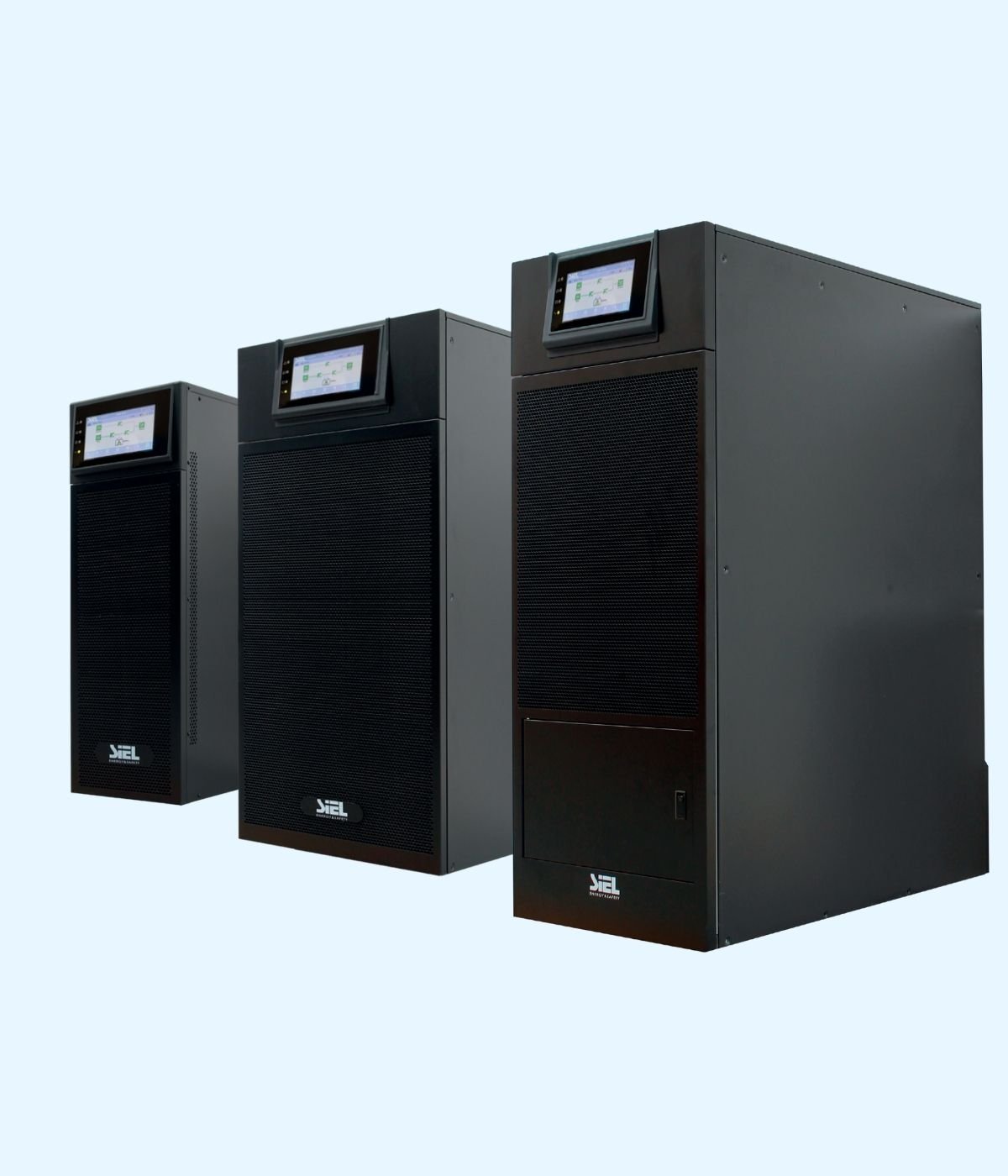
An 80kVA UPS in Kenya protects up to 80 kW of critical load, which suits a busy server room, a hospital theatre block, a bank data room or a factory’s control systems. At Encom, the two choices are the SIEL Safepower S 80K and the SIEL Safepower Evo HF 80K. Both are three-phase online double conversion units, and we quote them per project because the battery bank sets most of the cost.
Prices and specs checked on 27 October 2026.
Key takeaways
- Both SIEL 80kVA models deliver the full 80 kW, because their output power factor is 1.
- At full load, an 80kVA UPS draws about 115 A per phase on a 400 V three-phase supply.
- The Safepower S 80K weighs 147 kg and stands 1,100 mm tall, while the Evo HF 80K weighs 172 kg and stands 1,600 mm tall.
- Kenyan electricity users averaged 8.39 hours of outages and 3.52 interruptions a month, according to EPRA figures.
- Encom supplies SIEL on order, so every 80kVA UPS quote includes a battery bank sized for your runtime.
What is the 80kVA UPS price in Kenya?
There is no shelf price for an 80kVA UPS in Kenya, because the batteries change the total so much. For example, 10 minutes of backup at 80 kW needs a far smaller battery bank than one hour. So we quote each SIEL unit once we know your load, your runtime and your site. Also, all Encom prices exclude VAT.
In particular, four things move the final figure:
- The model. Safepower S or Safepower Evo HF, since they differ in parallel limits and battery options.
- The battery bank. Standard VRLA blocks, or lithium (LiFePO4) when you choose the Evo HF.
- Redundancy. One unit, or a parallel setup when downtime is not an option.
- Installation. Cabling, breakers and a bypass switch, as well as the battery cabinets.
What can an 80kVA UPS run?
Because its power factor is 1, a SIEL 80kVA UPS carries up to 80 kW of running load. However, we advise planning for about 80% of the rating, which is 64 kW. That margin covers growth, start-up surges and battery ageing.
For scale, average server racks still draw below 8 kW, according to the Uptime Institute’s 2024 survey. So a planned 64 kW covers at least eight average racks, as well as the network core. Similarly, it suits a theatre block with its monitoring, or the PLCs and drive controls of a production line.
Power is also the main reason sites go down. The Uptime Institute’s 2025 outage analysis states that “power remains the leading cause of impactful outages.”
What is the full load current of an 80kVA UPS?
At 400 V three-phase, an 80kVA UPS draws about 115 A per phase at full output. The formula is I = kVA × 1000 / (√3 × V), so 80,000 / (1.732 × 400) gives 115.5 A.
| Supply voltage | Current per phase at 80 kVA |
|---|---|
| 380 V | About 122 A |
| 400 V | About 115 A |
| 415 V | About 111 A |
What cable size does an 80kVA UPS need?
Your electrician sizes the cable from this current, the cable run and how the cable is laid. So we do not give one cable size for every site. In Kenya, this work falls under EPRA’s Electrical Installation Work Rules, which also cover licences for electricians and contractors.
Does an 80kVA UPS need three-phase power?
Yes. Both SIEL 80kVA models take a 380, 400 or 415 V three-phase supply with neutral, and they give a three-phase output. In contrast, the single-phase versions in these ranges stop at 20 kVA. So if your building only has single-phase power, talk to Kenya Power and your electrician first.
For more on per phase loads and balancing, read our guide on how to size a three phase UPS for your site.
SIEL Safepower S 80K vs Evo HF 80K
| Spec | Safepower S 80K | Safepower Evo HF 80K |
|---|---|---|
| Power | 80 kVA / 80 kW | 80 kVA / 80 kW |
| Online efficiency | Up to 96.5% | Up to 96.2% |
| Units in parallel | Up to 4 | Up to 8 |
| Batteries | External, VRLA | External, VRLA or LiFePO4 |
| Size (W x D x H) | 442 x 850 x 1100 mm | 500 x 830 x 1600 mm |
| Weight | 147 kg | 172 kg |
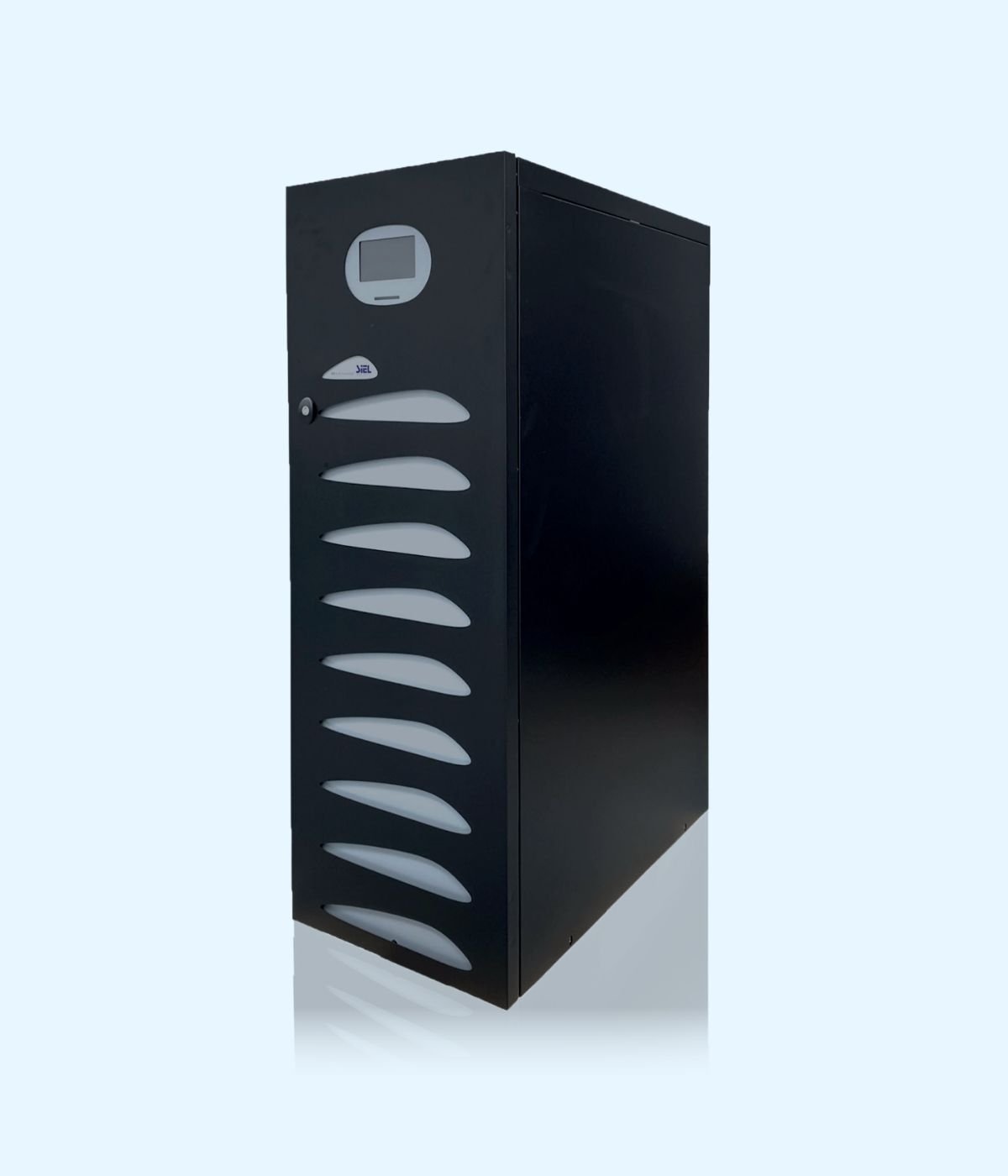
When to choose the Safepower S 80K
Pick the SIEL Safepower S 80K when you want a shorter, lighter cabinet and slightly higher efficiency. It also has a 7 inch touchscreen, as well as LAN, Modbus, dry contacts and a diesel mode input for generator sites. Its wide input range of 208 to 478 V and 40 to 70 Hz helps on weak or unstable supplies.
When to choose the Evo HF 80K
Pick the SIEL Safepower Evo HF 80K when you plan to grow or want lithium batteries. Up to eight units can run in parallel, so you can add capacity later. It also holds output distortion to 1.5% or less on IT loads. SIEL describes the range as “ideal for the protection of computer networks, telecommunications and critical systems in general.”
Is one 80kVA UPS better than several smaller units?
It depends on how much downtime you can accept. One 80kVA UPS is simpler and takes less floor space. However, if that unit fails, the load moves to bypass and runs on raw mains until it is fixed.
For that reason, many data rooms use N+1 instead. For example, three Evo HF 40K units in parallel share an 80 kW load, and any two can carry it alone. Alternatively, two 80K units in parallel give full redundancy for the same load. Our data centre UPS guide on redundancy and batteries explains N+1 and 2N in more detail, and our 40kVA SIEL guide covers the smaller building block.
How many batteries does an 80kVA UPS need?
Both SIEL 80kVA models use strings of 12 V blocks split around a centre point. The Evo HF 80K takes 40 blocks per string (20 + 20). Unlike the smaller Evo HF models, SIEL lists no internal battery space at 80K, so every block sits in external cabinets.
Meanwhile, the Safepower S 80K takes an adjustable string of 30 to 50 blocks, but the count matters. According to SIEL, 36 to 50 blocks give full power. In contrast, 32 or 34 blocks cut the output power factor to 0.9, or about 72 kW. Likewise, 30 blocks cut it to 0.8, or about 64 kW. So we never trim blocks to lower an 80kVA quote.
How long will an 80kVA UPS run on battery?
Runtime depends on your load and your battery bank, so there is no single answer. As a rough guide, 15 minutes at the full 80 kW means the batteries must deliver about 20 kWh, before losses and ageing. At half load, the same bank runs much longer.
Your target also depends on whether you have a generator. According to a Vertiv paper for the Battcon conference, UPS batteries have traditionally been sized for 15 minutes, since the UPS only bridges the gap until a generator takes over. As a result, we size from the maker’s discharge tables rather than simple division.
- With a generator: 10 to 15 minutes is usually enough, because the generator carries the long outage.
- Without a generator: plan for your longest likely outage instead. Kenyans face about 8.39 hours of outages a month, according to EPRA data reported by People Daily, against a regulator benchmark of 1.5 hours.
- Planned outages: Kenya Power posts its maintenance notices on its official X account, so check how long they last in your area.
What size generator suits an 80kVA UPS?
Plan for a generator of about 100 to 160 kVA when it only feeds the UPS. UK specialist UPS Systems suggests a generator of 1.25 to 2 times the UPS output, because a UPS input can heat the alternator.
That heating comes from distortion. Consulting-Specifying Engineer warns that “harmonic distortion can cause excessive heating at the generator”, and it notes that a 6-pulse rectifier typically has about 30% THD. By comparison, both SIEL 80K models keep input distortion at 3% or less, with an input power factor of 0.99. So your generator may not need the top of that ratio, although your electrician should confirm the final size.
How much heat does an 80kVA UPS give off?
At the full 80 kW and 96.5% efficiency, the Safepower S 80K loses about 2.9 kW as heat. Similarly, the Evo HF 80K at 96.2% loses about 3.2 kW. In ECO mode at 99%, the loss falls to about 0.8 kW.
Over a year at full load, 2.9 kW of losses adds up to about 25,000 kWh, so efficiency also shows on your power bill. Because of this, plan cooling for the UPS room as well as the server room. SIEL rates both models for 0 to 40 °C and up to 95% humidity without condensation. Since the cabinets are IP20, keep them indoors and away from dust.
How to get an 80kVA UPS quote in Kenya
To quote quickly, we need your load in kW or an equipment list, as well as your supply voltage. We also need your runtime and whether you have a generator. Then we come back with the right model and battery setup. Encom Digital is the only retailer of SIEL in Kenya and East Africa. Request a quote on WhatsApp on +254 714 962 072, or Email us.
If your load is smaller, see our 60kVA SIEL guide. On the other hand, if it is bigger, the Safepower S 120K and Evo HF 120K are the next step up. For factory sites, read our industrial UPS sizing guide. Finally, compare every range in our SIEL UPS buyer’s guide or browse the critical and industrial UPS range.
Frequently asked questions
80kVA UPS price and buying
What is the 80kVA UPS price in Kenya?
We quote SIEL 80kVA units per project, because the battery bank for your runtime sets most of the cost. Send us your load and runtime, and we will quote. Also, our prices exclude VAT.
Does the quote include batteries?
Yes. Every quote includes batteries and cabinets sized for your backup time, so you see the full cost.
Where can I buy a SIEL 80kVA UPS in Kenya?
Encom Digital in Nairobi is the only retailer of SIEL UPS systems in Kenya and East Africa. We supply each unit on order, so it is set up for your load.
Size, current and power
How many kW is an 80kVA UPS?
It depends on the power factor. SIEL 80kVA units have a power factor of 1, so they give 80 kW. In contrast, a unit rated 0.8 gives only 64 kW.
What is the full load current of an 80kVA UPS?
About 115 A per phase at 400 V three-phase. Similarly, it is about 122 A at 380 V and about 111 A at 415 V.
What is the size and weight of an 80kVA UPS?
The Safepower S 80K measures 442 x 850 x 1100 mm and weighs 147 kg. Meanwhile, the Evo HF 80K measures 500 x 830 x 1600 mm and weighs 172 kg, without batteries.
How much overload can an 80kVA UPS take?
Both SIEL models run 60 minutes at up to 110% load and 10 minutes at up to 125%. After 1 minute at up to 150%, the UPS moves to bypass. The Evo HF also runs at 103% with no time limit.
Batteries, generators and backup time
How many batteries are needed for an 80kVA UPS?
The Evo HF 80K uses 40 blocks of 12 V per string. Meanwhile, the Safepower S 80K takes 30 to 50 blocks, with full power from 36 blocks up.
Can an 80kVA UPS use lithium batteries?
Yes, on the Evo HF 80K. It ships with VRLA batteries as standard, while LiFePO4 is an option.
What size generator do I need for an 80kVA UPS?
Plan for about 100 to 160 kVA when the generator only feeds the UPS. Still, your electrician should confirm the size for your other loads.
Can two 80kVA units run together?
Yes. The Safepower S runs up to four units in parallel and the Evo HF up to eight, so you can add capacity or run N+1.